






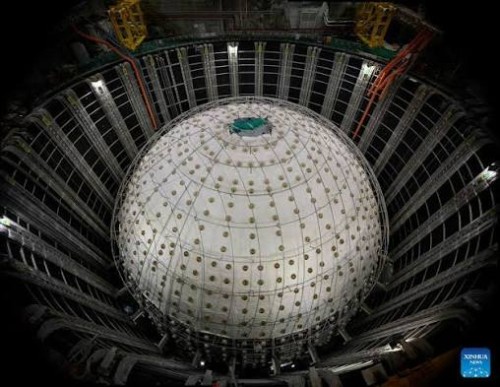
June 23—This past month, two teams of human beings reached into the two ends of the universe at once. In the hills of southern China, the JUNO observatory—a 20,000-ton sphere of liquid scintillator, watched by more than 43,000 light-sensors, 650 meters underground—caught the near-weightless flicker of the neutrino, and in just 59 days of operation measured the laws governing that ghostly particle more precisely than all prior experiments of recent decades combined. In those same weeks, the LIGO-Virgo-KAGRA collaboration published its latest catalog of gravitational waves: some 390 collisions of black holes and neutron stars have now been recorded—ripples in the fabric of spacetime itself, one of them traced to a merger more than three billion light-years away. A decade ago, we detected exactly one.
Neither the neutrino nor the black hole can be seen, heard, or touched. They lie, as Lyndon LaRouche wrote in 2010, beyond the reach of the senses altogether: “In the very large, as the very small, the metrics of sense-perception can no longer claim authority over the principles which reside, essentially, in what Riemann points to as those extremes of our universe.” And it is precisely there, he added—“in nothing as much as those same extremes”—that the deepest laws of the universe must be sought. To discover them, humanity does not wait for biological evolution to provide us with better eyes; we build new senses. Our species is the only one we know of that reaches past its own senses to grasp the very large and the very small and changes the universe by what we learn.
Let’s measure the present against that image of mankind.
In Switzerland, the first round of U.S.-Iran negotiations under the 14-point Islamabad Memorandum of Understanding concluded June 21 at the Bürgenstock resort, mediated by Qatar and Pakistan, with the U.S. and Iran not yet speaking directly. They agreed on a roadmap to a final deal within 60 days, a High-Level Committee to oversee it, and, most consequentially, a “de-confliction cell” to ensure the end of military operations in Lebanon—which Iran’s foreign minister called the “first real test” of the negotiations. That test is already underway: Israel refuses to leave southern Lebanon (and “nothing will change it,” Prime Minister Netanyahu insists), while Iran has tied the reopening of the Strait of Hormuz to a genuine Lebanese ceasefire. The potential for peace is real, and fragile.
Even should it hold, the damage is done and spreading. By energy-market reckoning, some 15 million barrels per day of oil—and its energy equivalent in liquefied natural gas—will be missing from world supply well into 2027, depressing an economy already enmeshed in the “everything bubble” of leveraged debt and derivatives. The effects will be felt, as they so often do, by the poorest. The UN’s latest “Hunger Hotspots” report warns that hundreds of millions face deepening hunger even as food and humanitarian aid is slashed. The same species that built JUNO is told there will not be enough food.
That is the contradiction of this moment. The species that can read the collision of black holes three billion years gone is told, by the managers of a dying system, that it cannot afford to house its young, feed the hungry, or build a railway across a desert. It is a failure of policy, not a lack of capability. Helga Zepp-LaRouche identifies the greatest failing directly: the refusal to recognize the indivisible nature of security and economic development of all nations. What Iran is insisting upon for relatively helpless Lebanon, and through Lebanon for the whole of the Global South, is what Pope Leo XIV’s encyclical Magnifica Humanitas states for all mankind—that no people may climb to heaven on a tower built by kicking the ladder away from the poor, as we said yesterday.
The Pope titled that encyclical “Magnificent Humanity.” The neutrino detector and the gravitational-wave catalog are examples of what that means—a fact about the creature said to be made in the image of the Creator, unlike any beast. Civilization organized around that truth would treat the development of every nation as the natural extension of the same creative power that built JUNO. A civilization that denies that truth of human nature, makes war on reservoirs and lets hundreds of millions go hungry.
Which of these we become is up to us. The decision is being made now, in the negotiating rooms at Lucerne, on the 60-day clock running toward a final deal, at this Friday’s International Peace Coalition mobilization, and in the streets of the nation soon to celebrate its 250th birthday. Let it be a celebration of what was once, and can be again, the great anti-colonial republic of the United States—a celebration led by LaRouche Presidential candidate Diane Sare, who will be holding an event in Philadelphia on July 5, joined by the irrepressible Congressional candidate Jose Vega.
The universe yields its deepest principles to those that reach for its extremes

June 12--A profound revolution in contemporary intellectual affairs has been proposed by Pope Leo XIV in his new Encyclical Magnifica Humanitas. More importantly, as seen in his recent trip to Spain, and the response he is eliciting, this first United States-born Pope is “walking his talk.” He is challenging the international War Party, and calling for a dialogue of civilizations that transcends the present failed and failing bankrupt geopolitics that is relentlessly driving humanity toward thermonuclear war.
Vatican News reports that “In the fifth chapter—The Culture of Power and the Civilization of Love—Pope Leo XIV turns his gaze to war, saying ‘the digital revolution is changing the nature of conflict.’ The Pope calls for an ethical approach, without which decisions about the life and death of persons will become increasingly impersonal due to a use of force regarded as an ‘immediate and viable option’ (182-183). At the root of all this is a ‘culture of power’ that normalizes war and rehabilitates it as an ‘instrument of international politics,’ favoring rearmament.”
The Pope, trained as an Augustinian, will be glad to know that the magnificence of humanity of which his encyclical’s title speaks is demonstrated through the science of technological progress that is the substance of physical economy. Speaking at the December 28, 1985 conference of the Schiller Institute, called “The Year of St. Augustine,” Lyndon LaRouche presented an affirmation of Leo’s theme, but from an ontological rather than theological standpoint:
“Man… is capable of Reason. Capable of seeing a lawful ordering in the universe, and using the knowledge of that lawful ordering to reform and change his own behavior. And in this way, by making reason rather than (Adam) Smith’s immediate and original instincts, bestial qualities, the characteristic of human behavior, by so doing, we achieve what we call scientific and technological progress. We not only increase man’s power over nature by bending man’s will to the law of Reason in the universe—by making the mind, not the bestial aspect of humanity, the personality, and the value, the identity of the person. We not merely increase the human population, but we elevate the possible moral condition of mankind—if we don’t have oligarchs to ruin the process—usurers, Venetian bankers, and the like. Then we begin to discover what is the Good…
“What is the Good? The Good is the power of mind to recognize a principle of Reason as a lawful ordering of the entire universe. To recognize that a process of development is associated with this, and to recognize that the continuation and acceleration of the takeover of the personality by elaborated Reason, is the Good! The elevation of the moral condition of mankind in correspondence with this principle, and in actions congruent with that principle, is the Good.
Such was the principle of Solon at Athens. Such was the principle of the Platonic Academy, the concept of the Republic. And such were the principles of the founding of the modern European republic by the writings of Saint Augustine. That is the Good. And the Republic is the only natural condition of mankind. And it was proven by Dante and his followers, that not only natural form of republic is a totally sovereign nation, state, not subject to the IMF, or the World Bank.”
In this 250th anniversary of the American Revolution, and in the days leading up to July 4, the LaRouche Organization continues its mission, not only to conduct a singular discussion of the world-historic strategic implications, of the Pope’s encyclical, but to find interlocutors in Russia, China, the trans-Atlantic filed states, and in the world capable of establishing a Council of Reason that allows humanity to survive the present “New Dark Age.” The failures of trans-Atlantic monetarism, the Epstein Class, must not be allowed to succeed in imposing their Satanic “will to power” on the world before their ultimate demise.
May 29—President Donald Trump has in his hands a Memorandum of Understanding, whose language has been agreed to by U.S. and Iranian negotiators, and which, according to reports, has been signed off on by the Iranian leadership. The deal, which will open the Strait of Hormuz and which will end Iran's nuclear weapons ambitions (if they ever had any), is the exit ramp Trump has searched for from this disastrous war that Israel's messianic lunatic Prime Minister Benjamin "Bibi" Netanyahu suckered the President into joining in his fool's-errand mission of regime change on Feb. 28.
The deal is acceptable to Trump, a source close to the White House said this morning, "but it is totally unacceptable to Bibi. He wanted a dysfunctional Iran, in total chaos, and one that Bibi could continue to fight. And, the deal will also restrain his genocidal operations against Lebanon and Hezbollah. In short, it is a strategic and political disaster for him. The question for Trump is: Does he have the guts to sign the deal and face the wrath of Bibi and his allies in the Zionist Lobby in the U.S.? The indications are that he will sign off on it."
Trump’s Strategy and Political Calculations
This and other sources say that Trump agreed to keep the Israelis at a distance while the negotiations on the wording of the MoU took place over the last several weeks. He has repeatedly told people that "Bibi cannot go against me. He will be forced to go along, whether he likes the deal or not." While critics in the MAGA camp, and Democrats, accurately argued that the Iran war was in Israel's interest and not the United States', Trump was maneuvering to cut a deal that was in his interest, and focused on two issues—the elimination of Iran's nuclear weapons capability and the reopening of the Strait of Hormuz to global traffic, reducing the effect on the global economy, which was headed towards a collapse in real production, including in food.
"The nuclear issue is critical for Trump politically," said the source close to the White House. "The crisis in the Strait was an effect of war, something that he had created. But removing Iran as a nuclear threat was a stated objective, not just of the United States but of Bibi and Israel. And the deal will do that, as the terms of future enrichment and the handling of Iran's 60% enriched uranium will be worked out over the next 30-60 days."
Leaks, Lobbying, and Resistance to the Deal
And there have been active measures to sabotage the deal coming from the media, in the form of leaks of its terms, as they were being negotiated. Trump, with his stupid bluster, contributes to this, but the leaks, coming from inside and around the White House to Axios, in particular, have only given the collection of Zionist lobby war hawks, like Sen. Lindsey Graham, a chance to yell, "sell out" and demand tougher terms.
The Z-lobby, including Sen. Graham, has also focused on the sanctions relief, and the release of billions in frozen Iranian assets, as well as allowing Iran to sell its oil and natural gas on the open markets. Graham has said that such monies will go to rebuild Iran's military capabilities to threaten Israel and its neighbors.
According to the Axios report yesterday, which other sources who have seen the MoU say is basically accurate, U.S. officials said terms of the deal were mostly agreed to as of Tuesday, but both sides still needed approval from senior leadership. The U.S. officials claimed the Iranians later came back and said they had the necessary approvals and were prepared to sign. Iran has not confirmed that. The U.S. negotiators, led by Special Envoy Steve Witkoff, briefed Trump on the details of the final deal, but he did not immediately sign off. "The president relayed to the mediators that he wants a couple of days to think about it," a U.S. official said.
Terms of the Proposed Agreement
The U.S. officials said the 60-day MoU states that shipping through the Strait of Hormuz will be "unrestricted." A U.S. official said this means no tolls and no harassment, and that Iran will have to remove all mines from the strait within 30 days. The U.S. naval blockade of Iranian ports will also be lifted, but that will happen in proportion to the restoration of commercial shipping, a U.S. official said. The U.S. would also issue some sanctions waivers to allow Iran to sell oil freely.
The MoU includes an Iranian commitment not to pursue a nuclear weapon, the officials said. It also states that the first issues to be negotiated during the 60-day window will be how to dispose of Iran's highly enriched uranium and how to address Iranian enrichment. The U.S. will commit to discuss sanctions relief and the release of frozen Iranian funds as part of the negotiations.
The MoU states that the war between Israel and Hezbollah in Lebanon would end.
Trump’s Public Messaging and Iranian Conditions
As this is being written, Trump is huddled with various officials and advisors, ostensibly to make a final determination on the MoU. Typical of his bombastic style of "negotiating," Trump already placed his thoughts on his Truth Social account to clarify some items.
“The enriched material, sometimes referred to as ‘Nuclear Dust,’ which is buried deep underground with virtually collapsed mountains, caused by our powerful B2 Bomber attack 11 months ago, sitting on top of it, will be unearthed by the United States … in close coordination and conjunction with the Islamic Republic of Iran, plus the International Atomic Energy Agency, and DESTROYED,” he wrote.
He also noted that “it is agreed” that the U.S. “is the only Country, along with China, with the mechanical capability” of extracting the uranium.
“Iran must agree that they will never have a Nuclear Weapon or Bomb.” Tehran would be barred from collecting tolls on ships in the Strait of Hormuz—ensuring “unrestricted shipping traffic, in both directions,” Trump said.
“All water mines (bombs), if any, will be terminated (we have removed, through detonation, numerous such mines with our great underwater mine sweepers,” he added.
While Trump said he was headed to the Situation Room to make a determination on the agreement, he appeared to hint that lifting the blockade on Iranian ports had already been decided, which White House tea-leaf readers say indicates that he may just agree to sign the MoU.
“Ships caught in the Strait due to our amazing and unprecedented Naval Blockade, which will now be lifted, may start the process of ‘heading home!’” he said. “Say HELLO to your wives, husbands, parents, and families from me, your favorite President!” Iran claimed it would not reopen the strait until the blockade is lifted, according to Fars—meaning Trump’s statement may have been an attempt to meet Tehran’s precondition.
But Iran’s top negotiator and parliamentary speaker, Mohammad Baqer Qalibaf, earlier Friday cryptically said Iran would not act on words alone.
Trump said that “no money will be exchanged, until further notice”—suggesting that economic relief measures with Iran may be taken up in future negotiations.
Regional Mediation and Consequences for Netanyahu
The developments come after Pakistani Foreign Minister Ishaq Dar arrived in Washington today for talks with Secretary of State Marco Rubio, as Islamabad continues to serve as a mediator in the agreement.
If Trump goes forward and signs the MoU, it will be hard for Bibi to cover up both the strategic and personal defeat it represents to him. Writes the sage strategic analyst Amos Harel in Haaretz, May 25: "The deal shaping up between the United States and Iran will express, if signed, a glorious American capitulation regarding the war that took place in the Gulf. It will also reflect Israel's waning influence on the moves of U.S. President Donald Trump... [I]t seemed that there would be a significant curbing of Iran's nuclear program in the best-case scenario. No attention to other problems most likely on the agenda, like ballistic missiles, aid to terror organizations in the Middle East and, more ambitiously, regime change in Tehran. This outcome would be a far cry from the promises of victory touted by Prime Minister Benjamin Netanyahu when he embarked on this war."
"What would Bibi do in response to his former friend if he signs this deal?" asked another source. "I would not rule anything out. Anything."
by Mr. X
March 29--“Planetary war.” That was the term used by Russian Foreign Intelligence Service (FSB) Director Sergei Naryshkin, in describing the silent interlacing of several of the more than sixty conflicts now occurring around the world. An example: journalist Kit Klarenberg reported May 24 on what he characterized as Ukraine’s Secret Al Qaeda Invasion of Africa: “On May 13th, French outlet RTL published an explosive report, entirely unremarked upon by English language media. It exposed how Ukrainian military and intelligence units are covertly operating in Mali on France’s behalf, in coordination with both ethnic Tuareg rebels and Al Qaeda-linked forces determined to crush the country’s revolutionary government.” Journalist John Helmer asserted in an interview this week that he believed that Ukrainian forces have been operating out of NATO facilities in Greece, or that NATO forces in Greece were launching attacks against Russia from NATO facilities—which would be far worse. These include unacknowledged NATO vs. Russia/China proxy wars in places like Mali, the “planetary war” which Naryshkin said may have already begun, at the International Security Forum in Moscow.
In a increasingly dangerous and volatile strategic arena — from the illegal aggression taken against Iran by the United States and Israel on Feb. 28th, to the deranged provocations of NATO-sponsored Ukrainian attacks on civilian targets in Russian territory — there is a severe shortage of thinking adults in the room to put an end to these conflicts, before they eventually lead us all into an inescapable thermonuclear showdown.
Following Ukraine’s attack of a Russian school dormitory in Starobelsk on the night of May 21-22—with the implicit consent of NATO countries—Russia launched a devastating, multi-weapon overnight counter-strike on March 23–including the use of its unstoppable Oreshnik missile—and then announced a series of “systematic strikes” that would be launched on key military-industrial complex facilities in Kiev. It also proclaimed an urgent warning that “foreign citizens, including diplomatic mission and international organization representative office personnel… leave the city as soon as possible.” This was not meant for Ukraine alone.
FSB Director Naryshkin did not mince words in his warning to the “Collective West,” advising Germany, in particular, not to repeat its experience of the first half of the 20th Century. “We know from the history of the first half of the 20th century how Germany takes responsibility for Europe. And how that ends—including for the Germans themselves—is well-known. Therefore, I would not advise them to repeat this experience," Naryshkin said.
In the United States, President Trump is telling the media—perhaps wishfully—that Iran is desperate to make a deal, while falsely claiming that its navy and air force have been obliterated despite the U.S. blatant failure to reopen the Strait of Hormuz. Meanwhile, American strategic assets are being deployed for what would become the third “official” war launched under the Trump administration, this time against Cuba, even as the country is being economically strangled into submission by sanctions.
As all of these frightening developments take place, the much-needed “adults in the room” are still convened in deliberations at the United Nations, under the leadership of China on the topic, “Upholding the Purposes and Principles of the UN Charter and Strengthening the UN-Centered International System.” There, Foreign Minister Wang Yi pointed to the need for a global reform of the international system to safeguard peace, with a strong emphasis on development. LaRouche forces have been assembled at the UN, both in the lead up to the meeting and during it. They have distributed, and delegates have received, the statement of Helga Zepp-LaRouche, “To the Governments of the United Nations: A Policy to Bring Peace and Development to Southwest Asia,” calling for a regional peace framework for Southwest Asia based on Lyndon LaRouche’s Oasis Plan. This would also be the immediate basis for a new security and development architecture to address the problems facing each and every country of the world at this very moment.
We of the post-imperial world have a choice of acting together as a cohesive force, presenting real solutions which can shape policy decisions, or allowing a descent into a civilizational collapse, the dimensions of which people have no appreciation. Candidates in the United States, such as Independent Presidential Candidate Diane Sare, and New York Congressional Candidate Jose Vega, represent the only path forward toward those solutions which can shape history. Will you join them, and others, to guide humanity out of its mad adolescence? Will you choose to be an adult in the room?
by Mr. X
May 29—The following was written May 24, prior to the special United Nations meeting convened by UNSC chairman China.
Before the world descends into a maelstrom of total war, from which human civilization itself may not emerge, a different path must need be taken. This Tuesday, May 26, the United Nations will convene the session, “Upholding the Purposes and Principles of the UN Charter and Strengthening the UN-Centered International System.” sponsored by the United Nations Security Council’s rotating Chairman, the People’s Republic of China. For the past week, LaRouche forces, and the International Peace Coalition (IPC), among others, have circulated, including at the UN itself, a proposal “To the Governments of the United Nations: A Policy To Bring Peace and Development to Southwest Asia.”
The statement reflects, in part the results of deliberations at the May 15 Executive Intelligence Review Roundtable, “The Iran War and the ‘Controlled Disintegration’ of the World Economy.” Participating were Schiller Institute founder Helga Zepp-LaRouche; former Prime Minister of Türkiye Ahmet Davutoğlu; Iranian Ambassador to Mexico Abolfazl Pasandideh; and former UN Special Rapporteur for Palestine Richard Falk, among others. In addition to a four-point proposal for advancing the cause of peace in Southwest Asia proposed at the EIR roundtable by Professor Davutoğlu, Zepp-LaRouche suggested an expansion of his proposals with “An integrated ‘Extended Oasis Plan,’ in which a program for reversing the desertification of Southwest Asia, modelled on China’s transformation of Xinjiang province and its northwest deserts, is combined with the extension of development corridors throughout Southwest Asia.”
That the world conversation on a new security and development architecture needs to immediately upshift to this solution concept could not be more evident, when the events of the past weekend are seen from the standpoint of their “existential threat” nature, rather than as “the latest news.” The Russian Defense Ministry’s website makes it clear that the Russian strike conducted on May 29 in response to the NATO/Ukrainian multiple drone assault on the vocational school at Starobelksk in Lugansk used Oreshnik missiles. It must be remembered, however, that, apart from whatever damage is reported to Ukraine in the next hours and days, the Oreshnik is a nuclear-capable missile, whose hypersonic impact has been described as nuclear-like. Apart from the fact that there is nothing in the NATO arsenal that can stop it, its potential “non-conventional” use is also intended to be understood “by those that have eyes to see and ears to hear.” As the entire massive and complicated strike, with drones and missiles, could not have been planned in a mere 24 hours, strategic analysts say this was not retaliation, but a clear message being sent to the NATO forces behind the Ukraine's attacks as to what is in store for them if the attacks continue.
But what about the blind, the deaf, and the really, really dumb, like the American “Lego Secretary of War?” (Stanley Kubrick’s “Col. Jack D. Ripper” is a model of sobriety, restraint and composure in comparison to Pete Hegseth.) It does not, and probably cannot occur to the “Epstein leadership class” of NATO, nor to those educated in the trans-Atlantic institutions of higher learning also run by the Epstein class, that their various “successful enterprises” of the past eight decades, in finance, “technocracy,” and most emphatically in the field of geopolitics, have produced a societal culture which is no longer morally fit to survive. It cannot conceive its own condition, and therefore, cannot perceive the clear and present danger of its own, even imminent thermonuclear extinction.
The roots of this rot are deeper still. In 1994, economist Lyndon LaRouche observed:
“Since no later than 1905, despite some elements of progress, even some admirable ones, the overall pattern of this century has been one of global decay of civilization through two ruinous world wars. Over the period since the assassination of U.S. President John F. Kennedy, there came a worse, presently ongoing collapse, into a neo-Malthusian ‘New Dark Age,’ into a ‘New Ager’s post-industrial Utopia.’ In the United States, compare the 63 years that have now passed since the JFK assassination, with the 63 years before it—1900 to 1963. Compare American progress in life expectancy, material standard of life, productivity in mining, manufacturing and agriculture, family formation, internal social progress, world prestige, and fundamental scientific advance, between 1900 and 1963, and 1963 and 2026. America needs its own ‘Oasis Plan.’”
That is the case of the U.S. What about the NATO nations, particularly Western Europe? Is there one nation which does not have negative population growth? Is the outcry about “the disappearance of Western civilization” because of “the invasion of Islam” in the U.K. and other areas, besides its obvious racialist overtones, merely a cover for the hatred of the human race that has resulted from King Charles and the Club Of Rome pushing negative population growth for 60 years? From a demographic standpoint—whether or not the society has a future, based on the growth of its population, and an improvement in its living standards—nearly all the states of NATO are failed states. The killing of children, as seen in the Israeli policy in Gaza, the Ukrainian attack in Lugansk, the broader self-immolation in the “war to the last Ukrainian” and perhaps the darker “night island entertainments” of the “Epstein Class,” are an expression of this underlying reality. Europe, too, needs an “Oasis Plan.”
Those who are urging that Russia use all military means to “decapitate” Ukraine, as Israel attempted to do with Iran, or to take other measures “that I would take, if I were head of Russia,” might reflect as to why they are, precisely because of that very “rush to judgment,” disqualified to be in charge of the world’s most powerful thermonuclear arsenal, particularly at this moment in current history. The whole human race must be taken into account by a leader that has the power to eliminate most, if not all of human and other forms of life, through a mistake. That same leader has the power to encourage the deployment of advanced technologies to rebuild the Earth, and advance humanity to other worlds. Civilization in leadership is not a luxury, but a requirement.
A barbaric society in possession of thermonuclear weapons will eventually cause those weapons to be used. Any idea of abdication of responsibility to machines to make humanity’s decisions, of a society “all watched over by machines of loving grace,” is even more certain to end the existence of humanity. Therefore, the only kind of societies the world can now afford are those capable of uniting the human race and educating the emotions of the world’s people to the idea that it is only in the benefit of the other that our own survival is assured.
The International Peace Coalition will reach a milestone this week. It will hold its 156th consecutive meeting—a meeting every week for three years straight. The “world citizens diplomacy” that is being forged in those meetings through the practice of Socratic dialogue is the means for the education of the emotions required to advance the practice of “peace through development” as the only sure way to ascend our nations from the maelstrom of total war.
There is a coincidence of opposites at work here—“that I can never be all that I can be, unless you are all that you can be,” as Martin Luther King once said. “We are caught in an inescapable network of mutuality, tied in a single garment of destiny. Whatever affects one directly, affects all indirectly.” The “oasis” of the “extended Oasis Plan,” which the United Nations should be encouraged this week, by all, to discuss, is the wellspring of a grounded optimism that holds the promise of a future greater than what might appear to be humanity’s tragic destiny. Be impractical—choose the benefit of the other.
May 23—Director of National Intelligence Tulsi Gabbard announced Thursday that she will resign at the end of June, citing a family medical crisis involving her husband, according to a resignation letter addressed to President Donald Trump.
In the letter, dated May 22, 2026, and marked "Unclassified," Gabbard said her husband, Abraham, was recently diagnosed with "an extremely rare form of bone cancer," prompting her decision to step away from public service.
"Unfortunately, I must submit my resignation, effective June 30, 2026," Gabbard wrote. "At this time, I must step away from public service to be by his side and fully support him through this battle."
Gabbard, a former Hawaii Democratic congresswoman and Army veteran, has served as director of national intelligence for 18 months. She thanked Trump for "the trust you placed in me and for the opportunity to lead the Office of the Director of National Intelligence."
Following her departure, Principal Deputy DNI Aaron Lukas will step up to serve as acting DNI until a permanent replacement is confirmed by the Senate.
Gabbard’s Intelligence Assessments on Iran
Although she has never contradicted or spoken out against Trump's sometimes wild mis-assertions of intelligence estimates, Gabbard has served as a sober counsel on matters. For example, she mobilized U.S. intelligence to present an assessment prior to last summer's strike against Iran that there was no intelligence to support Israeli assertions that Iran was close to developing a bomb or represented a threat to U.S. interests in the Gulf. When asked about this by Congress, she stated that it was up to the President to make the final determination.
Similarly, prior to the launching of the Feb. 28 joint Israeli-American aggression against Iran, she presented the President with American assessments that the attack would not lead to regime change, and could lead to Iranian attacks on Gulf states and the economic chaos of the closure of the Strait of Hormuz, while seriously delaying any deal on Iran's nuclear program.
Ukraine Assessments and European Security Concerns
In Europe, under Gabbard's direction, she repeatedly presented the President, sources report, with estimates that showed the eventual defeat of Ukraine by Russia, regardless of what support Ukraine was given. These estimates, sources report, warned of Russian potential to strike at European NATO targets, including American bases, if the Ukrainians should attack targets deep into Russia.
Clashes with Pentagon War Hawks
Such actions put Gabbard at odds with the lunatic war hawks in the Pentagon, including the messianic moron who is the Secretary of War, Pete Hegseth, who has attempted, often unsuccessfully, to use the Defense Intelligence Agency (DIA) to counter Gabbard's cautious assessments.
Sources report that Trump sometimes became frustrated with Gabbard for refusing to stovepipe intelligence to tell him what he wanted to hear. But these same sources say that Trump has a deep respect for her and her personal loyalty to him.
Trump Responds to Gabbard’s Departure
Trump responded on Truth Social after the announcement was made public, saying, "Unfortunately, after having done a great job, Tulsi Gabbard will be leaving the Administration on June 30th. Her wonderful husband, Abraham, has been recently diagnosed with a rare form of bone cancer, and she, rightfully, wants to be with him, bringing him back to good health as they currently fight a tough battle together. I have no doubt that he will soon be better than ever. Tulsi has done an incredible job, and we will miss her. Her highly respected Principal Deputy Director of National Intelligence, Aaron Lukas, will serve as Acting Director of National Intelligence."
May 22—Less than week remains before the high-level open debate on “Upholding the Purposes and Principles of the UN Charter and Strengthening the United Nations-Centered International System,” to be convened by China at the UN Security Council on May 26 as the culminating event of Beijing’s May rotating presidency. Chinese Foreign Minister Wang Yi will chair; UN Secretary-General António Guterres will brief the meeting.
China’s framing of the debate is direct, identifying more than 60 armed conflicts active today, “trust lacking among major countries, raising risk of major miscalculation,” and the “rise of power politics” and “bully practices” as the principal threats to the rule of law in international affairs. The language echoes Iranian Foreign Minister Abbas Araghchi’s address to the BRICS Foreign Ministers Meeting in New Delhi on May 14, in which he attacked “American bullying” and “declining imperialist powers.”
The debate is the immediate venue that Schiller Institute founder Helga Zepp-LaRouche identified at the May 15 EIR Emergency Roundtable for advancing the combined framework proposed by former Turkish Prime Minister Ahmet Davutoğlu—a new security architecture for the Middle East grounded in the equal sovereignty of nations—and Lyndon LaRouche’s Oasis Plan for economic development in the region. Davutoğlu agreed in dialogue with Zepp-LaRouche to personally contact the mediator nations he had proposed: Türkiye, Pakistan, Malaysia, and Indonesia.
The May 26 debate is the venue at which the new-paradigm framework—China’s explicit Charter theme, the convergent Davutoğlu architecture, the Russian critique of “neocolonial methods” advanced by Foreign Minister Sergey Lavrov, and the LaRouche movement’s economic-development perspective—can be put before the Security Council in a single setting.
With Wang Yi chairing and Guterres briefing, with the Putin-Xi joint declaration on a “multipolar world” already in the background, and with Trump’s reported willingness to delay strikes against Iran during the Hajj giving the diplomatic track unexpected breathing room, the May 26 debate is poised to be the most significant UN event so far this year for advancing the LaRouche framework.
May 22—The decision, which is still in process, to dissolve the Knesset and hold elections in Israel seems to be having an effect in loosening up the discussion process there. Public debates about genocide and apartheid are becoming more prominent.
Avraham Burg, former Speaker of the Israeli Knesset and one-time chairman of the Jewish Agency, has published a scathing assessment of Israel’s upcoming elections, arguing that the Israeli political system no longer offers voters any meaningful path away from the subjugation of Palestinians—only a choice between its cruder and more refined expressions: a choice between genocide and apartheid.
Writing in his Substack newsletter on May 21, Burg strips the election down to three layers. The surface layer is political theater—a talent show of egos competing over image and body count. Beneath it sits the years-long Netanyahu psychosis, which, he argues, has collapsed Israeli politics into a binary personality cult of “yes or no to Netanyahu,” crowding out any genuine debate over borders, occupation, or peace. But the deepest layer, Burg contends, is the one that unites nearly the entire establishment: a tacit acceptance that “Palestinians between the river and the sea, will never have real freedom.”
The Israeli right, he writes, has simply stopped concealing what it once euphemized, openly pursuing transfer and ethnic cleansing. But the liberal “alternative,” Burg argues, offers a more polished management of the same reality—occupation with a functioning High Court and “Jewish supremacy with softer constitutional language.” His conclusion is stark: the real electoral choice is between genocide or apartheid.
Burg’s piece carries unusual weight: He is not an outside critic but a former pillar of Labor Zionism who has spent two decades in painful public reckoning with its contradictions. The piece is, among other things, a eulogy for the political tradition he once embodied.
May 22—At the conclusion of Russian President Vladimir Putin’s and Chinese President Xi Jinping’s May 19-20 series of meetings and summit, the two governments issued a “Joint Statement of the Russian Federation and the People’s Republic of China on Further Strengthening Comprehensive Partnership and Strategic Interaction and on Deepening Relations of Good-Neighborliness, Friendship, and Cooperation.”
This document specified the two countries’ overview and plan for achieving a “multipolar world order,” “maintain[ing] progress in settlements in national currencies,” the expansion of trade, and so forth. One of the Joint Statement’s driving core concepts is collaboration in space development, including deep-space missions, building the International Lunar Research Station and satellites, etc., which will drive forth scientific-technological discoveries.
The parties agreed to continue implementing large-scale space projects that meet the shared interests of Russia and China and are included in their national space programs, actively promote cooperation, and systematically increase the level of interaction in key areas of space activities, including the International Lunar Research Station, lunar exploration, and deep space exploration….
The parties agreed to deepen mutually beneficial contacts in the field of satellite navigation, actively implement the Russian-Chinese roadmap for cooperation in satellite navigation for 2026–2030, and ensure the complementarity of the GLONASS and Beidou navigation systems for the benefit of users worldwide.
The parties expressed their readiness to continue strengthening Russian-Chinese cooperation in the coordination and use of radio frequencies and satellite orbits, and to continuously deepen Russian-Chinese cooperation and exchange of experience in the field of satellite internet….
Simultaneously, the two nations pledged to pursue a breath-taking undertaking in the widest array of the leading edges in both nuclear fission and fusion:
The parties intend to continue implementing the Tianwan Nuclear Power Plant and Xudapu Nuclear Power Plant construction projects, ensure the timely completion of construction work and commissioning of the facilities, and, on this basis, deepen cooperation in the peaceful use of nuclear energy, consistently promote cooperation in the areas of nuclear fusion, fast neutron reactors, and the closed nuclear fuel cycle, and develop cooperation in the form of package agreements in the area of the initial stage of the nuclear fuel cycle and the joint construction of new nuclear power plants based on the principles of mutual benefit and a balance of interests.
May 22—Professor Abdullah al-Ahsan, respected political scientist at the International Islamic University Malaysia and Istanbul Şehir University, endorsed former Turkish Prime Minister Ahmet Davutoğlu’s proposed Hormuz mediation framework in a May 21 commentary in Juan Cole’s Informed Comment. Al-Ahsan will be a featured speaker at the May 22 meeting of the International Peace Coalition.
Al-Ahsan considers Davutoğlu’s proposal—a joint maritime security force composed of Türkiye, Pakistan, Malaysia, and Indonesia to secure and temporarily administer the Strait of Hormuz—the most viable path out of the current standoff. The argument rests on what he calls “dual-acceptability”: these four nations have functional relationships with Tehran, the Gulf Cooperation Council, and Washington simultaneously, in a way no Western-led force can. Tehran, he writes, does not view these “prominent Muslim-majority democracies through the adversarial lens of imperial encirclement,” and Saudi Arabia and the GCC have substantial economic and diplomatic ties with each.
The geopolitical asset of dual acceptability—coupled with Davutoğlu’s personal standing as a “scholar-statesman” with “deep conceptual understanding of regional equilibrium and institutional diplomacy”—gives the proposal, in al-Ahsan’s reading, “immediate intellectual credibility” when presented at the UN Security Council and to the international community.
The piece arrives at a striking moment. Davutoğlu’s framework, set out in Project Syndicate in April and restated at the May 15 EIR Emergency Roundtable, is now taking the form of concrete diplomatic motion. During his meeting with Trump in Washington in early May, Brazilian President Luiz Inácio Lula da Silva handed Trump a copy of the 2010 Brazil-Türkiye-Iran Nuclear Agreement—the same framework Davutoğlu helped mediate as Türkiye’s foreign minister, under which Iran would deposit enriched uranium in Türkiye in exchange for civilian-use nuclear fuel. Pakistan’s General Asim Munir is in mediation discussions with Iran. And the May 26 Chinese-presided UN Security Council debate on the UN Charter is approaching as the immediate venue for advancing the framework.
Al-Ahsan’s intervention adds a respected Muslim-world scholarly voice to the convergence—and his appearance at tomorrow’s IPC meeting brings it directly into the network that has been advancing the proposal.
May 22—Sources close to the White House and familiar with ongoing negotiations to end the catastrophic war in Iran say that President Donald Trump is now considering a multi-stage approach that will end the war immediately, open the closed Strait of Hormuz, and allow for commitment by all parties to abide by existing U.N. resolutions and treaty agreements, including the Nuclear Non-Proliferation Treaty, of which Iran is a signatory and which bars it from developing a nuclear weapon. In exchange for compliance with this agreement, Iran will see the release of sanctions over time. In addition, the agreement calls for further negotiations to begin within seven days of signing on the specifics of Iran's nuclear program.
Saudi news channel Al Arabiya reported today that a draft agreement taking shape between the U.S. and Iran includes an immediate, comprehensive, and unconditional cease-fire across all arenas, according to unnamed sources familiar with the matter. However, the reported deal does not include any direct reference to the nuclear issue—a key sticking point for Israel, which had also been an issue for Trump.
According to these sources, the agreement is expected to be announced within "hours" and would take effect immediately following an official announcement by both sides. President Trump reiterated to reporters later today that Iran was "dying to make a deal."
Regional Mediation and Diplomatic Activity
Already in Tehran to push for the agreement, which would take the form of a Memorandum of Understanding, are the top Pakistani negotiators, Army Chief Field Marshal Asim Munir and Interior Minister Syed Mohsin Naqvi. At the same time, a Qatari negotiating team arrived in Tehran on Friday in coordination with the U.S. in an effort to help secure a deal to end the war with Iran and resolve outstanding issues, a source familiar with the matter told Reuters.
Meanwhile, both the Iranians and the U.S. threw some cold water on the prospects for a quick deal, with the Iranians saying that while differences were narrowing, there were still sizeable gaps in the two positions. Earlier Friday, however, U.S. Secretary of State Marco Rubio said negotiations had shown only "slight progress."
Draft Agreement and Strait of Hormuz Proposals
The Al Arabiya report adds that the draft includes a commitment not to target military, civilian, or economic infrastructure, as well as a halt to military operations and an end to the "media war" between the sides. It also emphasizes respect for the sovereignty and territorial integrity of states, alongside non-interference in their internal affairs.
In addition, the draft agreement includes guarantees to preserve freedom of navigation in the Persian Gulf, the Strait of Hormuz, and the Gulf of Oman, the establishment of a joint mechanism for oversight and dispute resolution, as well as the opening of negotiations on remaining disputed issues within seven days of the agreement taking effect.
Sources report that Iran has offered that the Strait be administered by an international body, created by the United Nations. Rather than collect "tolls" to be charged on individual ships, this body would collect fees from the oil cartel, OPEC, as well as from national oil and energy companies from non-OPEC states. A portion of these funds would be given to Iran and Oman. It is thought that such an arrangement would be acceptable to Trump.
Political Pressures on Trump
Trump continues to say that if no acceptable deal can be reached, he is prepared to relaunch the war, with a massive strike on Iran, including heavy attacks on civilian infrastructure. He had called off an attack that he claimed was scheduled for May 19 at the request of Pakistan, the UAE, and Saudi Arabia, who said that progress was being made on a peace deal. But some sources doubted that Trump had indeed ordered such an attack. Haaretz reported that the Israeli Defense Forces (IDF) were unaware of any planned attack and had no plans to initiate action on May 19.
Also, the timing—May 19—was bizarre in that it was the same day as key GOP primaries where Trump was seeking to oust opponents of his Iran war policy. Such an attack would have likely lost him those efforts, which, in the case of Rep. Tom Massie (Ky.) and Sen. Robert Cassidy (La.), he won and has been bragging about ever since.
"Trump has received the word—there is no support for the continuation of the war," said a source. "If the war continues, and the economic dislocation continues, he has been told, he will not just lose the midterm elections, he will be crushed. Trump can smile and say it is not true, but his polling numbers are at historic lows. And, he has been told by his negotiators that a bombing attack on Iran, which targets civilian infrastructure, will make matters worse and will not end the war.
Congressional Resistance and Strategic Calculations
"Trump needs a way out and the way out is accepting the best deal possible," the source continued, "and work with it. From his standpoint and not the Israelis. He says otherwise, but the majority of Americans believe that [Israeli Prime Minister Benjamin] Bibi Netanyahu suckered him into this unwinnable war that is in Israel's interests but not ours. This puts Trump squarely on the side of genocide, which is what Bibi is all about. And now he wants him to do this against the Iranian people which he claims to want to save."
Things got worse for Trump yesterday, when the GOP leadership in the House had to scramble and use legislative tricks to prevent a vote that had been scheduled on a War Powers resolution that would have forced Trump on paper to seek Congressional approval for the war. Two days ago, the GOP leadership was sure it would fail; by yesterday afternoon, they were sure it would pass, as much of the party was in revolt against what they saw as an out-of-touch President.
In addition, sources report that a similar resolution has a good chance to pass the Senate. Last week, it failed by one vote, 49-50. Now, Sen. Cassidy (R-La.), who Trump bragged about defeating, says he will vote against Trump and in favor of it.
Nuclear Negotiations and Prospects for Agreement
"The Iranians are watching all of this," said the source. "They are not stupid. Now, the key thing is that they must not be greedy. The war is a stupid mistake. They can last out in a war of attrition, but why should they cause their people to suffer, since they can get rid of the killer sanctions and become part of potential regional development plans."
This and other sources say that the two sides are also not really all that far apart on the nuclear program. Iran is reportedly willing to suspend its enrichment program for 15 years; Trump has asked for 20. The U.S. is reportedly willing to allow Iran to enrich small amounts of uranium for peaceful purposes, at new facilities that will be built above ground and be inspected by the UN's IAEA inspectors. Iran must close its existing underground sites, which were the subject of massive bombing in the 12-day war last summer. As for the 900 pounds of enriched uranium, which is reportedly buried at one of those sites and which new Supreme Leader Mojtaba Khamenei says Iran will never give up, sources say that Iran is indeed willing to turn it over to a third party, perhaps Türkiye, but more likely Russia.
"There's a deal here," said another source. "The same deal that could have been had without this stupid war. Trump has a way out, if he is smart enough to take it, and if he is willing to force Bibi to go along."
Negotiations are expected to continue into the weekend.
May 21—Middle East Eye reported on May 18 that the ICC prosecutor’s office last month filed a secret arrest warrant application for Israeli Finance Minister Bezalel Smotrich over alleged war crimes and crimes against humanity committed against Palestinians in the occupied West Bank. The charges against Smotrich, the self-anointed leader and spokesman for the settler's movement, reportedly include forced displacement as a crime against humanity and war crime, the transfer of Israel’s own population as a war crime into occupied territories, and persecution and apartheid as crimes against humanity.
In a letter to the ICC’s deputy prosecutors in March, which MEE says it has seen, Palestine’s mission to the Hague outlined further evidence of alleged war crimes and crimes against humanity by settlers and Israeli occupation forces. The letter also noted that Israel has failed to prosecute the alleged crimes. “The urgency to take action now cannot be overstated in any way, with the erasure and the destruction of the Palestinian people, as manifested by an illegal occupant, materializing by the day,” the letter read.
The prosecutor’s office has neither confirmed nor denied that it is seeking an arrest warrant for Smotrich.
Smotrich himself responded to the news by threatening to commit even more such crimes against the Palestinians: “Issuing arrest warrants against the prime minister is a declaration of war. Issuing arrest warrants against the minister of defense and the minister of finance [Smotrich] is a declaration of war. And in the face of a declaration of war, we will fight back with a vengeance.” He accused the Palestinian Authority of starting a war by engaging with the ICC to provide evidence.
Smotrich said that he is “very proud” of his settlement expansion policies. Then he made his vow: “From today, any economic or otherwise, anything that I can harm within the framework of my powers … will be attacked. Not talk and gimmicks—actions.” He proceeded to sign an immediate order to expel all the residents of Khan al-Ahmar, a village of Palestinian Bedouins near Jerusalem.
Peace Now, an Israeli anti-settlement watchdog group, responded: “Minister Smotrich seeks to take revenge on The Hague and the international community at the expense of one of the most vulnerable communities, which for years has struggled simply for the right to live on the small piece of land in its possession.” The destruction of the village is “part of a broader government plan to take control of the entire central West Bank area” and remove Palestinians from the area. Of note, the village lies in a tract of land where Israel’s government is establishing a new settlement bloc called E1. While all seizures of West Bank land are illegal, this E1 area is a strategic location whose absorption would make it virtually impossible to establish a viable and contiguous Palestinian state.
May 21—Israeli National Security Minister Itamar Ben Gvir posted a video May 20 celebrating his visit to a detention facility, where he taunted Gaza flotilla activists while they were forced to kneel on the ground, with their hands bound. Two days ago, the IDF illegally kidnapped them in international waters.
The video displayed Ben-Gvir as a deranged clown, viciously taunting the peaceful, bound detainees as if they were terrorists, was far beyond the bounds of normal propaganda, revealing him to be a Nazi-like sadist, who should be in some mental institution and not running Israel's security forces. So much international outrage broke out that even Prime Minister Netanyahu had to disassociate himself from Ben Gvir’s public sado-masochism.
As recounted by the Times of Israel, a female activist who shouted “Free Palestine” was grabbed by her head, then “shoved to the ground by officers who drag her out of Ben Gvir’s way, as he tours the facility where the proterstors were held. The treatment of the detainees appeared akin to security forces’ handling of the most severe terrorists in the prisons overseen by Ben Gvir’s office… With dozens of bound activists kneeling on the ground, Ben Gvir is seen waving a large Israeli flag and shouting in Hebrew, ‘Welcome to Israel! We are in charge here!’ Another shot pans through the kneeling activists, as Israel’s national anthem is blasted over a loudspeaker. Ben Gvir is subsequently seen shouting ‘Am Yisrael Chai’ (the nation of Israel lives) at a bound detainee trying to argue with him. As a woman is heard crying out, Ben Gvir is also heard urging guards at the facility ‘not [to] be bothered by their screams’.”
Italian Prime Minister Giorgia Meloni called the video “unacceptable,” that it violated the protestor's human dignity. She posted on X Italy’s action to retrieve her citizens and added: “Italy further demands an apology for the treatment of these demonstrators and for the utter contempt shown toward the explicit requests of the Italian government.” Israel’s ambassadors to Italy, France were summoned, with French Foreign Minister Jean-Noel Barrot tweeting: “Whatever one thinks of this flotilla… our compatriots who are participating in it must be treated with respect and released as quickly as possible.” South Korean President Lee Jae Myung called Israel’s actions “way out of line.” Statements from Spain and Ireland called out Ben Gvir’s “monstrous” and “appalling” behavior. The sister of Ireland’s President Catherine Connolly was one of the over 400 activists on board the flotillas.
As international outcry quickly mounted, Netanyahu issued the now standard disavowal that Minister Ben Gvir actions were “not in line with Israel’s values and norms.” Curiously, in the same statement, he asserted Israel’s “every right” to intervene in international waters to pre-empt their entry into “our territorial waters.”
Sources report that Natanyahu's government was furiously working with the zionist media machine to keep the video from being aired on American broadcast and legacy media, as it is sure to produce further outcry against Israel. It is already been shown over social media.
May 21—The UK Column, co-edited by EIR friend and associate, and British political maverick Mike Robinson in Plymouth, UK, has launched a quarterly journal under the name “The Column.” The first issue—Spring 2026—is a 126 page, glossy, full color collection of articles with the title “Deadly Deceptions—Inside the War Propaganda Machine,” with a picture of a Dove of Peace as a Trojan Horse firing at a fort with the words “It’s a gift from the Military Industrial Complex.”
The article on the cover title, “Fabricating the case for war in the 21st century,” is written by Katherine Gun, the former GCHQ intelligence analyst who was tried for leaking a memo showing that the CIA called on GCHQ to help spy on the United Nations, a story that was made into the film, Official Secrets. Vanessa Beeley writes on the Iran War and related US–Israel operations in the region. Mike Robinson himself writes an article on Israel’s Unit 8200, the IDF interface with the high tech sector in Israel, and another on how Trump’s break from Europe and NATO is driving the creation of a European Defense Union.
Other articles include:
•Dr. Piers Robinson on “Propaganda and the War Against Russia;”
•Patrick Henningsen, an associate of Mike Robinson at UK Column, reports on his visit to Iran just before the U.S./Israel war was launched, and another article on how NATO and Israel have driven the migration crisis in Europe.
There are also articles that cover the attack on the farm sector, the re-emergence of the Star Chamber in the UK legal system, the role of Parliament in British wars, and more.
To purchase a copy of The Column, which is 15 British pounds sterling(about $20) plus mailing, which varies, but is about $19, See https://shop.ukcolumn.org/product/the-column-issue-1/.
May 21—Russian Deputy Foreign Minister Sergei Ryabkov gave an interview to TASS May 19 in which he made a number of points:
- Strategic risks of a direct confrontation between NATO and Russia are growing, which may have catastrophic consequences: Ryabkov highlighted “the escalatory narrative” from European capitals about “the looming threat of a high-intensity war” with Russia. “As a result of this escalation of tensions, including blatantly provocative moves in the nuclear sphere, strategic risks are increasing, as is the danger of a head-on clash between NATO and our country, with potentially catastrophic consequences as a result,” he warned.
- Russia cannot overlook NATO’s growing aggregate nuclear capabilities and will take due account of that in its military planning: “We cannot ignore the obvious strengthening of the nuclear component of NATO’s overall capabilities, which is in fact taking place as a result of Europe’s efforts to develop its own nuclear capabilities in addition to the corresponding US ‘nuclear umbrella,’” he said. This “cannot go unaddressed in terms of Russian military planning, in particular, with regard to France’s efforts under its new strategy of the so-called forward nuclear deterrence,” he stressed.
- Russia and the West currently lack the military-political foundation necessary for security dialogue, and Western countries must take Moscow’s core interests into account to create such conditions: “The basic political and military-political foundation” for a substantial mutually acceptable dialogue “simply does not exist, and it is impossible to build it unless our Western counterparts are willing to genuinely take Russia’s fundamental interests into account and reliably resolve key contradictions in the security field,” he said.
- The US is persistently trying to force China to join arms control talks despite Beijing’s unwillingness: “The very idea of multilateral arms control talks among nuclear powers is being thwarted by the US’ persistent desire to make China’s participation mandatory. At the same time, Beijing’s consistent position of not participating in such talks at this stage is being ignored,” Ryabkov noted. He cited in particular, the positions of the UK and France, both of which categorically rejected participating in a hypothetical conversation about limiting nuclear arsenals.
“The obstacles to launching a multilateral dialogue among nuclear powers on arms control... are complex and difficult to overcome,” Ryabkov concluded.
- Russia will use military and technical means to repel any threats to it: “Our ability to influence these discussions [within NATO] stems primarily from the warnings we are sending to our Western opponents on both sides of the Atlantic regarding the risks they are creating and Russia’s determination to counter any new threats posed to us through military and technical means. We do this regularly in the hope of cooling the ‘hot heads’ in NATO capitals,” Ryabkov told TASS.
- Russia will respond proportionately if any country conducts nuclear tests: “In any case, the current situation requires our national infrastructure to be prepared in the event that the United States takes steps toward full-scale nuclear testing. We state that if any country conducts nuclear tests, we will respond appropriately and in due proportion,” Ryabkov emphasized.
May 21—Large-scale projects were advanced between Russia and China, as reported today by the head of the Russian Direct Investment Fund (RDIF), Kirill Dmitriev. He reported, “One agreement is in the field of satellites and, accordingly, satellite production, satellite launches, and joint work in the space industry. The second partnership is joint investment with the countries of the Shanghai Cooperation Organization (SCO)… There are many joint funds that have already been created there, and we will actively invest together with them.” Dmitriev said the third agreement focuses on infrastructure cooperation with “a leading Chinese architectural company,” which he said would help implement “very complex, comprehensive Russian-Chinese infrastructure projects.”
On his Max channel, Dmitriev identified the three partnerships: The first agreement was “with the Wenchang International Aerospace City Administration and China Construction Eighth Engineering Division.” The second, a signed agreement with the China-SCO Demonstration Zone and the Russian-Chinese Guild of Commerce, and the third as a signed agreement with the China Architecture Design & Research Group.
Further, Dmitriev was quoted by the Vesti Telegram channel, as reported by TASS, that the U.S. could be involved: “As part of RDIF, we are also looking at a number of projects involving both China and the United States. We believe that within the framework of partnership with China, a number of projects could also involve American investors.”
Further details were not specified, but the one obvious project that could involve the three countries is the Bering Strait tunnel. Dmitriev is a great fan of the project and has highlighted the project several times. In the context of last August’s Alaska summit between Russian President Vladimir Putin and US President Donald Trump, Dmitriev branded it the “Trump-Putin Tunnel.”
Less well known is that the project was also proposed in 2014 by China’s state-run Beijing Times’ coverage of Wang Mengshu, a railway expert at the Chinese Academy of Engineering: “Right now we’re already in discussions. Russia has already been thinking about this for many years.” He dubbed it the “China-Russia-Canada-America” line which could run for 13,000 km and take two days traveling time, averaging 350km/h (220 mph). Wand said that the tunnel technology is “already in place.”
The Beijing Times at the time said that the project was only one of four proposed international high-speed rail projects. The first would run from London via Paris, Berlin, Warsaw, Kiev and Moscow, where it would split into two routes, one running to China through Kazakhstan and the other through eastern Siberia. The second would begin in the far-western Chinese city of Urumqi and then run through Kazakhstan, Uzbekistan, Turkmenistan, Iran and Turkey to Germany. The third would begin in the south-western city of Kunming and end in Singapore.
One project that Putin had put a great priority on was the new Power of Siberia 2 pipeline to carry LNG to China. In order to finish and move forward in the most rapid way on this, which could ultimately help China decrease its reliance on Persian Gulf oil, contracts with pricing would have had be secured. No agreements were reached on this. Sources report that President Donald Trump, during his recent trip to China, had asked Xi not to make such a large open commitment to Russian energy at this time, as it remains under partial sanction due to the war Ukraine. Such a deal, sources report, would have been jumped on by the anti-China hawks, such as Senator Lindsey Graham (R-SC), to work against Trump's efforts to change the dynamic of U.S.-China relations in a positive way.
May 21—The Presidents of Russia and China signed a joint declaration on May 20 during Russian President Putin’s state visit to China on the principles of a new multipolar world order and “a new type of international relations.”
The statement is based on a series of similar declarations from 1997, 2005, 2017, and 2022, all of which highlight the needed and ongoing shift in the world away from neo-colonialism and hegemonism and toward a community of nations in which every country’s rights and development are respected and the voice of each is heard as an equal.
The May 20 declaration, “Joint Declaration of the Russian Federation and the People’s Republic of China on the Establishment of a Multipolar World and a New Type of International Relations” notes that “the attempts of a number of states to unilaterally manage global affairs, impose their interests on the entire world, and limit the possibilities for the sovereign development of other countries, in the spirit of the era of colonialism, have failed.” The document points to the dawning of a new era in which fundamental interests of all nations are respected “without dividing the world into opposing regions and blocs.”
The declaration also addresses the urgent need for a new security architecture: “[T]he security of one state cannot be achieved at the expense of the security of another. All sovereign states have an equal right to security,” the statement reads. “It is necessary to pay due attention to the rational security concerns of all countries, focus on cooperation on security issues, reject bloc confrontation and zero-sum game strategies, oppose the expansion of military alliances, hybrid wars, and proxy wars, and promote the creation of a renewed, balanced, effective, and sustainable global and regional security architecture.”
In order to improve the global governance system, the declaration calls for reform of the UN and other multilateral institutions to reflect the voice of developing nations in the international system.
“All human civilizations are valuable,” the statement reads. “All countries must advocate for a view of civilization based on equality, the mutual exchange of experiences, and dialogue.”
May 21—Russian President Putin traveled to China for a state visit on May 20 with his friend and counterpart Chinese President Xi Jinping, during which the two leaders accomplished what Putin characterized as “successful, intense, and fruitful work.”
Coming on the 25th anniversary of the Russia-China Treaty of Good-Neighborliness, Friendship and Cooperation (which the leaders renewed), the visit, and the Russia-China relationship in general, is an important intervention into an increasingly unstable world situation.
During a press conference following a series of one-on-one meetings between the presidents and larger gatherings of the high-level delegations, Xi and Putin both underscored the importance of the meeting:
“Under President Putin’s joint strategic leadership and mine, China-Russia relations have reached a new milestone,” Xi Jinping told reporters. “We must embrace the modern era’s trend toward peace, development, cooperation, and mutual benefit, and strive for the better development of China-Russia relations.”
“Relations between Russia and China have a stabilizing effect on global affairs,” Putin added. “Our close cooperation is especially important amid current international tensions.”
Accompanying the Russian president was a high-level delegation of government figures, and financial, economic, and industry leaders. More than 40 bilateral documents were agreed to on various facets of the Russia-China relationship, 20 of which were signed at a ceremony with Xi and Putin.
During the visit, the two presidents inaugurated the Russia-China Years of Education and agreed to extend visa-free travel between the two countries until the end of 2027.
Two important declarations on foreign policy and international relations were signed by the leaders, reflecting the conscious role that Russia and China continue to play in upholding international law and creating a new, just type of international relations.
“We are ready to work shoulder to shoulder to build a more just and rational system of global governance,” Xi stated in remarks to the press, “advancing along the path to the common good. The great cause of Chinese-Russian friendship, which responds to the spirit of history…will surely move forward, confidently, steadily, and relentlessly achieving ever new and remarkable achievements.”
May 20—The following is the unofficial draft for first part the May 17 Schiller Institute Chorus event celebrating America's 250th, which contains most of the texts read.
PROLOGUE—ELVIRA GREEN
(INTONED OR SUNG)
IN ‘76 THE SKY WAS RED
THUNDER RUMBLING OVERHEAD
AND KING GEORGE COULD’T SLEEP IN HIS BED
AND ON THAT STORMY MORN
OLD UNCLE SAM WAS BORN
Those words are from a 1939 Cantata called “Ballad For Americans.” Ballad for Americans was performed on November 5, 1939, for a CBS radio show called "The Pursuit of Happiness," produced by Norman Corwin. The person that sang those words was Paul Robeson. Robeson, who spoke over 20 languages and sang in over 50, truly personified all of America, with his deep, rich bass.
10 years later, Paul Robeson would be blacklisted. In 1950 his passport would be taken without any indictment or formal charges placed against him. He was {disappeared} from American life for 9 years. Paul Robeson didn’t change. The United States changed.
In the 1960s, America once again changed in a new, positive direction. Assassinations changed it again, in a most tragic direction.
America has a complicated relationship with change. This country was given birth in a Declaration of Independence, and later a Constitution, that changed space and time forever. But America’s realization of that Declaration has often fallen short of its noble aspirations.
Poet Langston Hughes posed the paradox of America in these words:
O, let America be America again—
The land that never has been yet—
And yet must be—the land where every man is free.
The land that's mine—the poor man's, Indian's, Negro's, ME—…”
Who is “me?” Is “me” the tired, the poor, the “huddled masses yearning to breathe free” described by poet Emma Lazarus’ words, written at the base of the Statue of Liberty?
Some say, “No!” What do you, what do we say? Are we America?
Our Declaration of Independence tell us: “But when a long Train of Abuses and Usurpations, pursuing invariably the same Object, evinces a Design to reduce them under absolute Despotism, it is their Right, it is their Duty, to throw off such Government, and to provide new Guards for their future Security.”
But how? In what way can we become the new Guardians of the Declaration’s promise?
We propose that we are America; that artists must become the new Guards of our security; and that it is only through Beauty that we will proceed to true Freedom.
We proclaim that the old, displaced, forgotten Songs of Freedom, that infused the words, and fortified the mission of the many different people that gave birth to this nation, over and over, in our first 250 years, hold the emotional key to our national salvation today. Those songs, even today, carry a power greater than that of the false force of arms. It is from the immortal fountain of this art, forged in slavery, war and revolution, that we must take the living water that can cleanse us, nourish us, and refresh us for the next 250 years and more.
We welcome you to your nation, and this celebration of “The land that never has been yet—
And yet must be—the land where every man is free.
“Kenst du das Land?” Do you know this land? It is, after all, yours.
CHORUS: "Lily of the Valley"
ELVIRA GREEN—“Prudence, indeed, will dictate that Governments long established should not be changed for light and transient Causes; and accordingly all Experi- ence hath shewn, that Mankind are more disposed to suffer, while Evils are sufferable, than to right themselves by abolishing the forms to which they are accustomed."
JONATHAN KRUK—"The Long Train"
CHORUS: "By and by"
ELVIRA GREEN: “We hold these Truths to be self-evident, that all Men are created equal, that they are endowed by their Creator with certain unalienable Rights, that among these are Life, Liberty, and the Pursuit of Happiness—That to secure these Rights, Governments are instituted among Men, deriving their just Powers from the Consent of the Governed, that whenever any form of Government becomes destructive of these Ends, it is the Right of the People to alter or to abolish it, and to institute new Government, laying its Foundation on such Principles, and organizing its Powers in such form, as to them shall seem most likely to effect their Safety and Happiness.”
CHORUS: "AIN’T A THAT GOOD NEWS"
ELVIRA GREEN: “A MASSACHUSETTS PETITION"
To the Honorable Council and House of Representatives for the State of Massachusetts Bay, in General Court assembled January 13, 1777 – the Petition of a great number of Negroes who are detained in a state of Slavery in the Bowels of a free and Christian Country, Humbly Showing –
That your Petitioners apprehend that they have in common with all other Men, a natural and unalienable right to that freedom which the great Parent of the Universe had bestowed equally on all Mankind, and wish they have never forfeited, by any compact or agreement whatever –
but that they were unjustly dragged, by the cruel hand of power, from their dearest friends, and some of them even torn from the embraces of their tender parents, from a populous, pleasant and plentiful Country –
and in Violation of the Laws of Nature, and of Nation, and the defiance of all the tender feedings of humanity, brought hither, to be sold like Beasts of Burden, and like them condemned to Slavery for Life, Among (a) people professing the mild Religion of Jesus –
A People not insensible of the sweets of rational freedom – nor without spirit to resent the unjust endeavors of others to reduce {them} to a State of Bondage and Subjection –
your Honors need not to be informed, that a life of Slavery, like that of your petitioners, deprived of every social privilege, of everything requisite to render Life even tolerable, is far worse than Non-existence –
They cannot express their astonishment, that it has never been considered, that every principle from which America has acted in the course of her unhappy difficulties with Great Britain, pleas stronger than a thousand arguments in favor of your Petitioners –
They therefore humbly beseech your Honors, to give this Petition its due weight and consideration, and cause an act of the Legislature to be passed, whereby they may be restored to the enjoyment of that freedom which is the natural right of all Men and their Children (who were born in this Land of Liberty) may not be held as Slaves after they arrive at the age of 21 years –
so may the Inhabitants of this State, (no longer chargeable with the inconsistency of acting themselves, the part which they condemn and oppose in others) be prospered in their present glorious struggles for Liberty; and have those blessings secured to them by Heaven, of which benevolent minds cannot wish to deprive their fellow Men.
And your Petitioners, as in Duty Bound, shall ever pray.
Lancaster Hill
Peter Best
Prince Hall
Brister Slenser
Newport Sumner
Nero Funelo
Jack Pierpont
Job Lock
THEY ARE FOUNDERS. SAY THEIR NAMES.
JONATHAN KRUK: A passage written for our Declaration of Independence, but removed from the final draft.
“[The King]has waged cruel war against human nature itself, violating its most sacred rights of life and liberty in the persons of a distant people who never offended him, captivating & carrying them into slavery in another hemisphere or to incur miserable death in their transportation thither. This piratical warfare, the opprobrium of infidel powers, is the warfare of the CHRISTIAN King of Great Britain. Determined to keep open a market where MEN should be bought & sold, he has prostituted his negative for suppressing every legislative attempt to prohibit or restrain this execrable commerce.
"And that this assemblage of horrors might want no fact of distinguished die, he is now exciting those very people to rise in arms among us, and to purchase that liberty of which he has deprived them, by murdering the people on whom he has obtruded them: thus paying off former crimes committed against the Liberties of one people, with crimes which he urges them to commit against the lives of another."
KEVIN THOMPSON: O FREEDOM
JONATHAN KRUK: 1787, Gouveneur Morris Speaks Out Against Slavery—
"The admission of slaves into the representation, when fairly explained, comes to this, – that the inhabitant of Georgia and South Carolina, who goes to the coast of Africa, and in defiance of the most sacred laws of humanity, tears away his fellow creatures from their dearest connections and damns them to the most cruel bondage, shall have more votes in a government instituted for protection of the rights of mankind, than the citizen of Pennsylvania or New Jersey who views with a laudable horror so nefarious of practice."
CHORUS: My soul’s been anchored in the Lord
JONATHAN KRUK: FIRST RHODE ISLAND
ELVIRA GREEN: LEMUEL HAYNES: "LEXINGTON"
Although our numbers were but few
And they a numerous throng
Yet we their armies do pursue
And drive their hosts along
One son of freedom could annoy
A thousand tyrant fiends
And their despotic tribe destroy
And chase them to their dens
Thus did the sons of Britain’s King
Receive a sore disgrace
Whilst sons of freedom joined to sing
The victory they embrace
CHORUS: Chester
CHORUS: HIS NAME SO SWEET
JONATHAN KRUK: "When, in the course of human events, it becomes necessary for one people to dissolve the bands which have connected them with another, and to assume among the powers of the earth the separate and equal station to which the laws of nature and nature’s God entitle them, a decent respect for the opinions of mankind requires that they should declare the causes which impel them to the separation.”
ELVIRA GREEN: The Declaration of Independence was composed and drafted 250 years ago by a Committee of Five: Ben Franklin, John Adams, Robert Livingston, Roger Sherman and Thomas Jefferson. The committee appointed Jefferson to draft the Declaration, and he did so, between June 11 and June 28. That draft was then reviewed and revised by John Adams and Ben Franklin.
Of its beginning, Professor Danielle Allen, in her book "Our Declaration," wrote:
”We have to begin by focusing on the very beginning, just one clause to start: 'When in the course of human events, it becomes necessary for one people…' That beginning seems overdone. Why not just say, 'When it becomes necessary…'? Why add 'in the course of human events '? And what exactly is 'the course of human events' anyway?
Since 'course' is another word for 'river,' an image of a waterway lies behind this sentence. Although Jefferson may not have been thinking explicitly about rivers when he wrote the first draft, the language itself, the word 'course,' has this useful image built into it. We can use this image of a river to work our way into the sentence.
A river has a definite shape. An infinity of droplets combine into a single flow, all moving together in the current in one direction. And all that water is rolling towards some knowable destination. The muddy Mississippi, for instance, may meander, but it descends inevitably into the Gulf of Mexico.”
Professor Allen is correct. But what is this river of events? William Shakespeare, in Act Five of Julius Caesar, wrote:
“There is a tide in the affairs of men.
Which, taken at the flood, leads on to fortune;
Omitted, all the voyage of their life
Is bound in shallows and in miseries.
On such a full sea are we now afloat,
And we must take the current when it serves,
Or lose our ventures."
This was the "course of human events" that ran before, during and after that moment in 1776.
Only poets, and artists, know the river’s true source. Poet Percy Shelley said:
The everlasting universe of things
Flows through the mind, and rolls its rapid waves, Now dark—now glittering—now reflecting gloom—
Now lending splendor, where from secret springs The source of human thought its tribute brings
Of waters—with a sound but half its own.
EVERETT SUTTLE: Three solos—
The Boatman’s Dance
Zion’s Walls
Shenandoah
KEVIN THOMPSON: Ol’ Man River
EPILOGUE
"America goes not abroad, in search of monsters to destroy. She well knows that by once enlisting under other banners than her own, were they even the banners of foreign Independence, she would involve herself beyond the power of extrication, in all the wars of interest and intrigue, of individual avarice, envy, and ambition, which assume the colors and usurp the standard of freedom.
"The fundamental maxims of her policy would insensibly change from liberty to force.The frontlet upon her brow would no longer beam with the ineffable splendor of Freedom and Independence; but in its stead would soon be substituted an Imperial Diadem, flashing in false and tarnished lustre the murky radiance of dominion and power. She might become the dictatress of the world. She would be no longer the ruler of her own spirit."
What would John Quincy Adams, Secretary of State, later President of the United States, who spoke those words on the Fourth of July in 1821, think of America today? More to the point, what would he do about America today?
On July 4, 1826, exactly 200 years ago this July 4, John Quincy Adams’ Father, John Adams, the second President of the United States, died. On that exact same day, Thomas Jefferson, the third President of the United States, the penman of the Declaration of Independence, also died. Opposite in many ways, imperfect in many ways, they were two of the Committee of Five that wrote a revolution more perfect than themselves.
That revolution in thought is not the property of the people that wroteit, or the people that profess it. It is the property of the people that believe it, and act on it, everywhere in the world. John Quincy Adams was right: if America is the dictatress of the world, America is a slave to despotism. It is no longer the master of its own spirit. It is no longer America.
So, what America are we? Sovereign, or enslaved? Are we “The land that never has been yet, and yet must be?” Kennst du das Land? America, know thyself!!!
May 20—On Sunday, May 17, the Schiller Institute NYC Chorus held an enormously successful concert on New York City’s Upper West Side, with the title “America’s 250th in Music & Lore.” It was opened by opera legend soprano Elvira Green, who read an excerpt from Langston Hughes’ poem:
O, let America be America again—
The land that has never been yet—
And yet must be…
Ms. Green delivered historical narratives, including the “Massachusetts Petition,” and alternated with master storyteller Jonathan Kruk, who delivered anti-slavery speeches by John Quincy Adams and Gouverneur Morris. All of this was interwoven with spirituals sung by a chorus of 70 people.
After the singing of Chester, America’s first national anthem, the narration shifted to the “course of human events,” and the Declaration of American Independence, which introduced a series of “river songs”: The Boatman’s Dance, Zion’s Walls, and Shenandoah, all sung by tenor Everett Suttle, and then bass singer Kevin Thompson brought down the house with Old Man River.
The second part of the program opened with Mozart’s Ave Verum Corpus, which asks its listeners to contemplate their own mortality, and was followed by Beethoven’s Choral Fantasy, the refrain of which is “When love and power are united, then mankind has earned divine grace.” The performance was done with two pianos instead of piano and orchestra and was spectacular.
Everyone stayed for the reception following the program, with almost everybody reporting how much they had learned! One woman, a retired African-American opera singer, reported that when she came in, she had already decided not to commemorate America’s 250th at all, but she has now changed her mind.
The concert video and program can be found at https://www.sinycchorus.com/america_s_250th_in_music_lore
June 23—This past month, two teams of human beings reached into the two ends of the universe at once. In the hills of southern China, the JUNO observatory—a 20,000-ton sphere of liquid scintillator, watched by more than 43,000 light-sensors, 650 meters underground—caught the near-weightless flicker of the neutrino, and in just 59 days of operation measured the laws governing that ghostly particle more precisely than all prior experiments of recent decades combined. In those same weeks, the LIGO-Virgo-KAGRA collaboration published its latest catalog of gravitational waves: some 390 collisions of black holes and neutron stars have now been recorded—ripples in the fabric of spacetime itself, one of them traced to a merger more than three billion light-years away. A decade ago, we detected exactly one.
Neither the neutrino nor the black hole can be seen, heard, or touched. They lie, as Lyndon LaRouche wrote in 2010, beyond the reach of the senses altogether: “In the very large, as the very small, the metrics of sense-perception can no longer claim authority over the principles which reside, essentially, in what Riemann points to as those extremes of our universe.” And it is precisely there, he added—“in nothing as much as those same extremes”—that the deepest laws of the universe must be sought. To discover them, humanity does not wait for biological evolution to provide us with better eyes; we build new senses. Our species is the only one we know of that reaches past its own senses to grasp the very large and the very small and changes the universe by what we learn.
Let’s measure the present against that image of mankind.
In Switzerland, the first round of U.S.-Iran negotiations under the 14-point Islamabad Memorandum of Understanding concluded June 21 at the Bürgenstock resort, mediated by Qatar and Pakistan, with the U.S. and Iran not yet speaking directly. They agreed on a roadmap to a final deal within 60 days, a High-Level Committee to oversee it, and, most consequentially, a “de-confliction cell” to ensure the end of military operations in Lebanon—which Iran’s foreign minister called the “first real test” of the negotiations. That test is already underway: Israel refuses to leave southern Lebanon (and “nothing will change it,” Prime Minister Netanyahu insists), while Iran has tied the reopening of the Strait of Hormuz to a genuine Lebanese ceasefire. The potential for peace is real, and fragile.
Even should it hold, the damage is done and spreading. By energy-market reckoning, some 15 million barrels per day of oil—and its energy equivalent in liquefied natural gas—will be missing from world supply well into 2027, depressing an economy already enmeshed in the “everything bubble” of leveraged debt and derivatives. The effects will be felt, as they so often do, by the poorest. The UN’s latest “Hunger Hotspots” report warns that hundreds of millions face deepening hunger even as food and humanitarian aid is slashed. The same species that built JUNO is told there will not be enough food.
That is the contradiction of this moment. The species that can read the collision of black holes three billion years gone is told, by the managers of a dying system, that it cannot afford to house its young, feed the hungry, or build a railway across a desert. It is a failure of policy, not a lack of capability. Helga Zepp-LaRouche identifies the greatest failing directly: the refusal to recognize the indivisible nature of security and economic development of all nations. What Iran is insisting upon for relatively helpless Lebanon, and through Lebanon for the whole of the Global South, is what Pope Leo XIV’s encyclical Magnifica Humanitas states for all mankind—that no people may climb to heaven on a tower built by kicking the ladder away from the poor, as we said yesterday.
The Pope titled that encyclical “Magnificent Humanity.” The neutrino detector and the gravitational-wave catalog are examples of what that means—a fact about the creature said to be made in the image of the Creator, unlike any beast. Civilization organized around that truth would treat the development of every nation as the natural extension of the same creative power that built JUNO. A civilization that denies that truth of human nature, makes war on reservoirs and lets hundreds of millions go hungry.
Which of these we become is up to us. The decision is being made now, in the negotiating rooms at Lucerne, on the 60-day clock running toward a final deal, at this Friday’s International Peace Coalition mobilization, and in the streets of the nation soon to celebrate its 250th birthday. Let it be a celebration of what was once, and can be again, the great anti-colonial republic of the United States—a celebration led by LaRouche Presidential candidate Diane Sare, who will be holding an event in Philadelphia on July 5, joined by the irrepressible Congressional candidate Jose Vega.
The universe yields its deepest principles to those that reach for its extremes
June 12--A profound revolution in contemporary intellectual affairs has been proposed by Pope Leo XIV in his new Encyclical Magnifica Humanitas. More importantly, as seen in his recent trip to Spain, and the response he is eliciting, this first United States-born Pope is “walking his talk.” He is challenging the international War Party, and calling for a dialogue of civilizations that transcends the present failed and failing bankrupt geopolitics that is relentlessly driving humanity toward thermonuclear war.
Vatican News reports that “In the fifth chapter—The Culture of Power and the Civilization of Love—Pope Leo XIV turns his gaze to war, saying ‘the digital revolution is changing the nature of conflict.’ The Pope calls for an ethical approach, without which decisions about the life and death of persons will become increasingly impersonal due to a use of force regarded as an ‘immediate and viable option’ (182-183). At the root of all this is a ‘culture of power’ that normalizes war and rehabilitates it as an ‘instrument of international politics,’ favoring rearmament.”
The Pope, trained as an Augustinian, will be glad to know that the magnificence of humanity of which his encyclical’s title speaks is demonstrated through the science of technological progress that is the substance of physical economy. Speaking at the December 28, 1985 conference of the Schiller Institute, called “The Year of St. Augustine,” Lyndon LaRouche presented an affirmation of Leo’s theme, but from an ontological rather than theological standpoint:
“Man… is capable of Reason. Capable of seeing a lawful ordering in the universe, and using the knowledge of that lawful ordering to reform and change his own behavior. And in this way, by making reason rather than (Adam) Smith’s immediate and original instincts, bestial qualities, the characteristic of human behavior, by so doing, we achieve what we call scientific and technological progress. We not only increase man’s power over nature by bending man’s will to the law of Reason in the universe—by making the mind, not the bestial aspect of humanity, the personality, and the value, the identity of the person. We not merely increase the human population, but we elevate the possible moral condition of mankind—if we don’t have oligarchs to ruin the process—usurers, Venetian bankers, and the like. Then we begin to discover what is the Good…
“What is the Good? The Good is the power of mind to recognize a principle of Reason as a lawful ordering of the entire universe. To recognize that a process of development is associated with this, and to recognize that the continuation and acceleration of the takeover of the personality by elaborated Reason, is the Good! The elevation of the moral condition of mankind in correspondence with this principle, and in actions congruent with that principle, is the Good.
Such was the principle of Solon at Athens. Such was the principle of the Platonic Academy, the concept of the Republic. And such were the principles of the founding of the modern European republic by the writings of Saint Augustine. That is the Good. And the Republic is the only natural condition of mankind. And it was proven by Dante and his followers, that not only natural form of republic is a totally sovereign nation, state, not subject to the IMF, or the World Bank.”
In this 250th anniversary of the American Revolution, and in the days leading up to July 4, the LaRouche Organization continues its mission, not only to conduct a singular discussion of the world-historic strategic implications, of the Pope’s encyclical, but to find interlocutors in Russia, China, the trans-Atlantic filed states, and in the world capable of establishing a Council of Reason that allows humanity to survive the present “New Dark Age.” The failures of trans-Atlantic monetarism, the Epstein Class, must not be allowed to succeed in imposing their Satanic “will to power” on the world before their ultimate demise.
May 29—President Donald Trump has in his hands a Memorandum of Understanding, whose language has been agreed to by U.S. and Iranian negotiators, and which, according to reports, has been signed off on by the Iranian leadership. The deal, which will open the Strait of Hormuz and which will end Iran's nuclear weapons ambitions (if they ever had any), is the exit ramp Trump has searched for from this disastrous war that Israel's messianic lunatic Prime Minister Benjamin "Bibi" Netanyahu suckered the President into joining in his fool's-errand mission of regime change on Feb. 28.
The deal is acceptable to Trump, a source close to the White House said this morning, "but it is totally unacceptable to Bibi. He wanted a dysfunctional Iran, in total chaos, and one that Bibi could continue to fight. And, the deal will also restrain his genocidal operations against Lebanon and Hezbollah. In short, it is a strategic and political disaster for him. The question for Trump is: Does he have the guts to sign the deal and face the wrath of Bibi and his allies in the Zionist Lobby in the U.S.? The indications are that he will sign off on it."
Trump’s Strategy and Political Calculations
This and other sources say that Trump agreed to keep the Israelis at a distance while the negotiations on the wording of the MoU took place over the last several weeks. He has repeatedly told people that "Bibi cannot go against me. He will be forced to go along, whether he likes the deal or not." While critics in the MAGA camp, and Democrats, accurately argued that the Iran war was in Israel's interest and not the United States', Trump was maneuvering to cut a deal that was in his interest, and focused on two issues—the elimination of Iran's nuclear weapons capability and the reopening of the Strait of Hormuz to global traffic, reducing the effect on the global economy, which was headed towards a collapse in real production, including in food.
"The nuclear issue is critical for Trump politically," said the source close to the White House. "The crisis in the Strait was an effect of war, something that he had created. But removing Iran as a nuclear threat was a stated objective, not just of the United States but of Bibi and Israel. And the deal will do that, as the terms of future enrichment and the handling of Iran's 60% enriched uranium will be worked out over the next 30-60 days."
Leaks, Lobbying, and Resistance to the Deal
And there have been active measures to sabotage the deal coming from the media, in the form of leaks of its terms, as they were being negotiated. Trump, with his stupid bluster, contributes to this, but the leaks, coming from inside and around the White House to Axios, in particular, have only given the collection of Zionist lobby war hawks, like Sen. Lindsey Graham, a chance to yell, "sell out" and demand tougher terms.
The Z-lobby, including Sen. Graham, has also focused on the sanctions relief, and the release of billions in frozen Iranian assets, as well as allowing Iran to sell its oil and natural gas on the open markets. Graham has said that such monies will go to rebuild Iran's military capabilities to threaten Israel and its neighbors.
According to the Axios report yesterday, which other sources who have seen the MoU say is basically accurate, U.S. officials said terms of the deal were mostly agreed to as of Tuesday, but both sides still needed approval from senior leadership. The U.S. officials claimed the Iranians later came back and said they had the necessary approvals and were prepared to sign. Iran has not confirmed that. The U.S. negotiators, led by Special Envoy Steve Witkoff, briefed Trump on the details of the final deal, but he did not immediately sign off. "The president relayed to the mediators that he wants a couple of days to think about it," a U.S. official said.
Terms of the Proposed Agreement
The U.S. officials said the 60-day MoU states that shipping through the Strait of Hormuz will be "unrestricted." A U.S. official said this means no tolls and no harassment, and that Iran will have to remove all mines from the strait within 30 days. The U.S. naval blockade of Iranian ports will also be lifted, but that will happen in proportion to the restoration of commercial shipping, a U.S. official said. The U.S. would also issue some sanctions waivers to allow Iran to sell oil freely.
The MoU includes an Iranian commitment not to pursue a nuclear weapon, the officials said. It also states that the first issues to be negotiated during the 60-day window will be how to dispose of Iran's highly enriched uranium and how to address Iranian enrichment. The U.S. will commit to discuss sanctions relief and the release of frozen Iranian funds as part of the negotiations.
The MoU states that the war between Israel and Hezbollah in Lebanon would end.
Trump’s Public Messaging and Iranian Conditions
As this is being written, Trump is huddled with various officials and advisors, ostensibly to make a final determination on the MoU. Typical of his bombastic style of "negotiating," Trump already placed his thoughts on his Truth Social account to clarify some items.
“The enriched material, sometimes referred to as ‘Nuclear Dust,’ which is buried deep underground with virtually collapsed mountains, caused by our powerful B2 Bomber attack 11 months ago, sitting on top of it, will be unearthed by the United States … in close coordination and conjunction with the Islamic Republic of Iran, plus the International Atomic Energy Agency, and DESTROYED,” he wrote.
He also noted that “it is agreed” that the U.S. “is the only Country, along with China, with the mechanical capability” of extracting the uranium.
“Iran must agree that they will never have a Nuclear Weapon or Bomb.” Tehran would be barred from collecting tolls on ships in the Strait of Hormuz—ensuring “unrestricted shipping traffic, in both directions,” Trump said.
“All water mines (bombs), if any, will be terminated (we have removed, through detonation, numerous such mines with our great underwater mine sweepers,” he added.
While Trump said he was headed to the Situation Room to make a determination on the agreement, he appeared to hint that lifting the blockade on Iranian ports had already been decided, which White House tea-leaf readers say indicates that he may just agree to sign the MoU.
“Ships caught in the Strait due to our amazing and unprecedented Naval Blockade, which will now be lifted, may start the process of ‘heading home!’” he said. “Say HELLO to your wives, husbands, parents, and families from me, your favorite President!” Iran claimed it would not reopen the strait until the blockade is lifted, according to Fars—meaning Trump’s statement may have been an attempt to meet Tehran’s precondition.
But Iran’s top negotiator and parliamentary speaker, Mohammad Baqer Qalibaf, earlier Friday cryptically said Iran would not act on words alone.
Trump said that “no money will be exchanged, until further notice”—suggesting that economic relief measures with Iran may be taken up in future negotiations.
Regional Mediation and Consequences for Netanyahu
The developments come after Pakistani Foreign Minister Ishaq Dar arrived in Washington today for talks with Secretary of State Marco Rubio, as Islamabad continues to serve as a mediator in the agreement.
If Trump goes forward and signs the MoU, it will be hard for Bibi to cover up both the strategic and personal defeat it represents to him. Writes the sage strategic analyst Amos Harel in Haaretz, May 25: "The deal shaping up between the United States and Iran will express, if signed, a glorious American capitulation regarding the war that took place in the Gulf. It will also reflect Israel's waning influence on the moves of U.S. President Donald Trump... [I]t seemed that there would be a significant curbing of Iran's nuclear program in the best-case scenario. No attention to other problems most likely on the agenda, like ballistic missiles, aid to terror organizations in the Middle East and, more ambitiously, regime change in Tehran. This outcome would be a far cry from the promises of victory touted by Prime Minister Benjamin Netanyahu when he embarked on this war."
"What would Bibi do in response to his former friend if he signs this deal?" asked another source. "I would not rule anything out. Anything."
by Mr. X
March 29--“Planetary war.” That was the term used by Russian Foreign Intelligence Service (FSB) Director Sergei Naryshkin, in describing the silent interlacing of several of the more than sixty conflicts now occurring around the world. An example: journalist Kit Klarenberg reported May 24 on what he characterized as Ukraine’s Secret Al Qaeda Invasion of Africa: “On May 13th, French outlet RTL published an explosive report, entirely unremarked upon by English language media. It exposed how Ukrainian military and intelligence units are covertly operating in Mali on France’s behalf, in coordination with both ethnic Tuareg rebels and Al Qaeda-linked forces determined to crush the country’s revolutionary government.” Journalist John Helmer asserted in an interview this week that he believed that Ukrainian forces have been operating out of NATO facilities in Greece, or that NATO forces in Greece were launching attacks against Russia from NATO facilities—which would be far worse. These include unacknowledged NATO vs. Russia/China proxy wars in places like Mali, the “planetary war” which Naryshkin said may have already begun, at the International Security Forum in Moscow.
In a increasingly dangerous and volatile strategic arena — from the illegal aggression taken against Iran by the United States and Israel on Feb. 28th, to the deranged provocations of NATO-sponsored Ukrainian attacks on civilian targets in Russian territory — there is a severe shortage of thinking adults in the room to put an end to these conflicts, before they eventually lead us all into an inescapable thermonuclear showdown.
Following Ukraine’s attack of a Russian school dormitory in Starobelsk on the night of May 21-22—with the implicit consent of NATO countries—Russia launched a devastating, multi-weapon overnight counter-strike on March 23–including the use of its unstoppable Oreshnik missile—and then announced a series of “systematic strikes” that would be launched on key military-industrial complex facilities in Kiev. It also proclaimed an urgent warning that “foreign citizens, including diplomatic mission and international organization representative office personnel… leave the city as soon as possible.” This was not meant for Ukraine alone.
FSB Director Naryshkin did not mince words in his warning to the “Collective West,” advising Germany, in particular, not to repeat its experience of the first half of the 20th Century. “We know from the history of the first half of the 20th century how Germany takes responsibility for Europe. And how that ends—including for the Germans themselves—is well-known. Therefore, I would not advise them to repeat this experience," Naryshkin said.
In the United States, President Trump is telling the media—perhaps wishfully—that Iran is desperate to make a deal, while falsely claiming that its navy and air force have been obliterated despite the U.S. blatant failure to reopen the Strait of Hormuz. Meanwhile, American strategic assets are being deployed for what would become the third “official” war launched under the Trump administration, this time against Cuba, even as the country is being economically strangled into submission by sanctions.
As all of these frightening developments take place, the much-needed “adults in the room” are still convened in deliberations at the United Nations, under the leadership of China on the topic, “Upholding the Purposes and Principles of the UN Charter and Strengthening the UN-Centered International System.” There, Foreign Minister Wang Yi pointed to the need for a global reform of the international system to safeguard peace, with a strong emphasis on development. LaRouche forces have been assembled at the UN, both in the lead up to the meeting and during it. They have distributed, and delegates have received, the statement of Helga Zepp-LaRouche, “To the Governments of the United Nations: A Policy to Bring Peace and Development to Southwest Asia,” calling for a regional peace framework for Southwest Asia based on Lyndon LaRouche’s Oasis Plan. This would also be the immediate basis for a new security and development architecture to address the problems facing each and every country of the world at this very moment.
We of the post-imperial world have a choice of acting together as a cohesive force, presenting real solutions which can shape policy decisions, or allowing a descent into a civilizational collapse, the dimensions of which people have no appreciation. Candidates in the United States, such as Independent Presidential Candidate Diane Sare, and New York Congressional Candidate Jose Vega, represent the only path forward toward those solutions which can shape history. Will you join them, and others, to guide humanity out of its mad adolescence? Will you choose to be an adult in the room?
by Mr. X
May 29—The following was written May 24, prior to the special United Nations meeting convened by UNSC chairman China.
Before the world descends into a maelstrom of total war, from which human civilization itself may not emerge, a different path must need be taken. This Tuesday, May 26, the United Nations will convene the session, “Upholding the Purposes and Principles of the UN Charter and Strengthening the UN-Centered International System.” sponsored by the United Nations Security Council’s rotating Chairman, the People’s Republic of China. For the past week, LaRouche forces, and the International Peace Coalition (IPC), among others, have circulated, including at the UN itself, a proposal “To the Governments of the United Nations: A Policy To Bring Peace and Development to Southwest Asia.”
The statement reflects, in part the results of deliberations at the May 15 Executive Intelligence Review Roundtable, “The Iran War and the ‘Controlled Disintegration’ of the World Economy.” Participating were Schiller Institute founder Helga Zepp-LaRouche; former Prime Minister of Türkiye Ahmet Davutoğlu; Iranian Ambassador to Mexico Abolfazl Pasandideh; and former UN Special Rapporteur for Palestine Richard Falk, among others. In addition to a four-point proposal for advancing the cause of peace in Southwest Asia proposed at the EIR roundtable by Professor Davutoğlu, Zepp-LaRouche suggested an expansion of his proposals with “An integrated ‘Extended Oasis Plan,’ in which a program for reversing the desertification of Southwest Asia, modelled on China’s transformation of Xinjiang province and its northwest deserts, is combined with the extension of development corridors throughout Southwest Asia.”
That the world conversation on a new security and development architecture needs to immediately upshift to this solution concept could not be more evident, when the events of the past weekend are seen from the standpoint of their “existential threat” nature, rather than as “the latest news.” The Russian Defense Ministry’s website makes it clear that the Russian strike conducted on May 29 in response to the NATO/Ukrainian multiple drone assault on the vocational school at Starobelksk in Lugansk used Oreshnik missiles. It must be remembered, however, that, apart from whatever damage is reported to Ukraine in the next hours and days, the Oreshnik is a nuclear-capable missile, whose hypersonic impact has been described as nuclear-like. Apart from the fact that there is nothing in the NATO arsenal that can stop it, its potential “non-conventional” use is also intended to be understood “by those that have eyes to see and ears to hear.” As the entire massive and complicated strike, with drones and missiles, could not have been planned in a mere 24 hours, strategic analysts say this was not retaliation, but a clear message being sent to the NATO forces behind the Ukraine's attacks as to what is in store for them if the attacks continue.
But what about the blind, the deaf, and the really, really dumb, like the American “Lego Secretary of War?” (Stanley Kubrick’s “Col. Jack D. Ripper” is a model of sobriety, restraint and composure in comparison to Pete Hegseth.) It does not, and probably cannot occur to the “Epstein leadership class” of NATO, nor to those educated in the trans-Atlantic institutions of higher learning also run by the Epstein class, that their various “successful enterprises” of the past eight decades, in finance, “technocracy,” and most emphatically in the field of geopolitics, have produced a societal culture which is no longer morally fit to survive. It cannot conceive its own condition, and therefore, cannot perceive the clear and present danger of its own, even imminent thermonuclear extinction.
The roots of this rot are deeper still. In 1994, economist Lyndon LaRouche observed:
“Since no later than 1905, despite some elements of progress, even some admirable ones, the overall pattern of this century has been one of global decay of civilization through two ruinous world wars. Over the period since the assassination of U.S. President John F. Kennedy, there came a worse, presently ongoing collapse, into a neo-Malthusian ‘New Dark Age,’ into a ‘New Ager’s post-industrial Utopia.’ In the United States, compare the 63 years that have now passed since the JFK assassination, with the 63 years before it—1900 to 1963. Compare American progress in life expectancy, material standard of life, productivity in mining, manufacturing and agriculture, family formation, internal social progress, world prestige, and fundamental scientific advance, between 1900 and 1963, and 1963 and 2026. America needs its own ‘Oasis Plan.’”
That is the case of the U.S. What about the NATO nations, particularly Western Europe? Is there one nation which does not have negative population growth? Is the outcry about “the disappearance of Western civilization” because of “the invasion of Islam” in the U.K. and other areas, besides its obvious racialist overtones, merely a cover for the hatred of the human race that has resulted from King Charles and the Club Of Rome pushing negative population growth for 60 years? From a demographic standpoint—whether or not the society has a future, based on the growth of its population, and an improvement in its living standards—nearly all the states of NATO are failed states. The killing of children, as seen in the Israeli policy in Gaza, the Ukrainian attack in Lugansk, the broader self-immolation in the “war to the last Ukrainian” and perhaps the darker “night island entertainments” of the “Epstein Class,” are an expression of this underlying reality. Europe, too, needs an “Oasis Plan.”
Those who are urging that Russia use all military means to “decapitate” Ukraine, as Israel attempted to do with Iran, or to take other measures “that I would take, if I were head of Russia,” might reflect as to why they are, precisely because of that very “rush to judgment,” disqualified to be in charge of the world’s most powerful thermonuclear arsenal, particularly at this moment in current history. The whole human race must be taken into account by a leader that has the power to eliminate most, if not all of human and other forms of life, through a mistake. That same leader has the power to encourage the deployment of advanced technologies to rebuild the Earth, and advance humanity to other worlds. Civilization in leadership is not a luxury, but a requirement.
A barbaric society in possession of thermonuclear weapons will eventually cause those weapons to be used. Any idea of abdication of responsibility to machines to make humanity’s decisions, of a society “all watched over by machines of loving grace,” is even more certain to end the existence of humanity. Therefore, the only kind of societies the world can now afford are those capable of uniting the human race and educating the emotions of the world’s people to the idea that it is only in the benefit of the other that our own survival is assured.
The International Peace Coalition will reach a milestone this week. It will hold its 156th consecutive meeting—a meeting every week for three years straight. The “world citizens diplomacy” that is being forged in those meetings through the practice of Socratic dialogue is the means for the education of the emotions required to advance the practice of “peace through development” as the only sure way to ascend our nations from the maelstrom of total war.
There is a coincidence of opposites at work here—“that I can never be all that I can be, unless you are all that you can be,” as Martin Luther King once said. “We are caught in an inescapable network of mutuality, tied in a single garment of destiny. Whatever affects one directly, affects all indirectly.” The “oasis” of the “extended Oasis Plan,” which the United Nations should be encouraged this week, by all, to discuss, is the wellspring of a grounded optimism that holds the promise of a future greater than what might appear to be humanity’s tragic destiny. Be impractical—choose the benefit of the other.
May 23—Director of National Intelligence Tulsi Gabbard announced Thursday that she will resign at the end of June, citing a family medical crisis involving her husband, according to a resignation letter addressed to President Donald Trump.
In the letter, dated May 22, 2026, and marked "Unclassified," Gabbard said her husband, Abraham, was recently diagnosed with "an extremely rare form of bone cancer," prompting her decision to step away from public service.
"Unfortunately, I must submit my resignation, effective June 30, 2026," Gabbard wrote. "At this time, I must step away from public service to be by his side and fully support him through this battle."
Gabbard, a former Hawaii Democratic congresswoman and Army veteran, has served as director of national intelligence for 18 months. She thanked Trump for "the trust you placed in me and for the opportunity to lead the Office of the Director of National Intelligence."
Following her departure, Principal Deputy DNI Aaron Lukas will step up to serve as acting DNI until a permanent replacement is confirmed by the Senate.
Gabbard’s Intelligence Assessments on Iran
Although she has never contradicted or spoken out against Trump's sometimes wild mis-assertions of intelligence estimates, Gabbard has served as a sober counsel on matters. For example, she mobilized U.S. intelligence to present an assessment prior to last summer's strike against Iran that there was no intelligence to support Israeli assertions that Iran was close to developing a bomb or represented a threat to U.S. interests in the Gulf. When asked about this by Congress, she stated that it was up to the President to make the final determination.
Similarly, prior to the launching of the Feb. 28 joint Israeli-American aggression against Iran, she presented the President with American assessments that the attack would not lead to regime change, and could lead to Iranian attacks on Gulf states and the economic chaos of the closure of the Strait of Hormuz, while seriously delaying any deal on Iran's nuclear program.
Ukraine Assessments and European Security Concerns
In Europe, under Gabbard's direction, she repeatedly presented the President, sources report, with estimates that showed the eventual defeat of Ukraine by Russia, regardless of what support Ukraine was given. These estimates, sources report, warned of Russian potential to strike at European NATO targets, including American bases, if the Ukrainians should attack targets deep into Russia.
Clashes with Pentagon War Hawks
Such actions put Gabbard at odds with the lunatic war hawks in the Pentagon, including the messianic moron who is the Secretary of War, Pete Hegseth, who has attempted, often unsuccessfully, to use the Defense Intelligence Agency (DIA) to counter Gabbard's cautious assessments.
Sources report that Trump sometimes became frustrated with Gabbard for refusing to stovepipe intelligence to tell him what he wanted to hear. But these same sources say that Trump has a deep respect for her and her personal loyalty to him.
Trump Responds to Gabbard’s Departure
Trump responded on Truth Social after the announcement was made public, saying, "Unfortunately, after having done a great job, Tulsi Gabbard will be leaving the Administration on June 30th. Her wonderful husband, Abraham, has been recently diagnosed with a rare form of bone cancer, and she, rightfully, wants to be with him, bringing him back to good health as they currently fight a tough battle together. I have no doubt that he will soon be better than ever. Tulsi has done an incredible job, and we will miss her. Her highly respected Principal Deputy Director of National Intelligence, Aaron Lukas, will serve as Acting Director of National Intelligence."
May 22—Less than week remains before the high-level open debate on “Upholding the Purposes and Principles of the UN Charter and Strengthening the United Nations-Centered International System,” to be convened by China at the UN Security Council on May 26 as the culminating event of Beijing’s May rotating presidency. Chinese Foreign Minister Wang Yi will chair; UN Secretary-General António Guterres will brief the meeting.
China’s framing of the debate is direct, identifying more than 60 armed conflicts active today, “trust lacking among major countries, raising risk of major miscalculation,” and the “rise of power politics” and “bully practices” as the principal threats to the rule of law in international affairs. The language echoes Iranian Foreign Minister Abbas Araghchi’s address to the BRICS Foreign Ministers Meeting in New Delhi on May 14, in which he attacked “American bullying” and “declining imperialist powers.”
The debate is the immediate venue that Schiller Institute founder Helga Zepp-LaRouche identified at the May 15 EIR Emergency Roundtable for advancing the combined framework proposed by former Turkish Prime Minister Ahmet Davutoğlu—a new security architecture for the Middle East grounded in the equal sovereignty of nations—and Lyndon LaRouche’s Oasis Plan for economic development in the region. Davutoğlu agreed in dialogue with Zepp-LaRouche to personally contact the mediator nations he had proposed: Türkiye, Pakistan, Malaysia, and Indonesia.
The May 26 debate is the venue at which the new-paradigm framework—China’s explicit Charter theme, the convergent Davutoğlu architecture, the Russian critique of “neocolonial methods” advanced by Foreign Minister Sergey Lavrov, and the LaRouche movement’s economic-development perspective—can be put before the Security Council in a single setting.
With Wang Yi chairing and Guterres briefing, with the Putin-Xi joint declaration on a “multipolar world” already in the background, and with Trump’s reported willingness to delay strikes against Iran during the Hajj giving the diplomatic track unexpected breathing room, the May 26 debate is poised to be the most significant UN event so far this year for advancing the LaRouche framework.
May 22—The decision, which is still in process, to dissolve the Knesset and hold elections in Israel seems to be having an effect in loosening up the discussion process there. Public debates about genocide and apartheid are becoming more prominent.
Avraham Burg, former Speaker of the Israeli Knesset and one-time chairman of the Jewish Agency, has published a scathing assessment of Israel’s upcoming elections, arguing that the Israeli political system no longer offers voters any meaningful path away from the subjugation of Palestinians—only a choice between its cruder and more refined expressions: a choice between genocide and apartheid.
Writing in his Substack newsletter on May 21, Burg strips the election down to three layers. The surface layer is political theater—a talent show of egos competing over image and body count. Beneath it sits the years-long Netanyahu psychosis, which, he argues, has collapsed Israeli politics into a binary personality cult of “yes or no to Netanyahu,” crowding out any genuine debate over borders, occupation, or peace. But the deepest layer, Burg contends, is the one that unites nearly the entire establishment: a tacit acceptance that “Palestinians between the river and the sea, will never have real freedom.”
The Israeli right, he writes, has simply stopped concealing what it once euphemized, openly pursuing transfer and ethnic cleansing. But the liberal “alternative,” Burg argues, offers a more polished management of the same reality—occupation with a functioning High Court and “Jewish supremacy with softer constitutional language.” His conclusion is stark: the real electoral choice is between genocide or apartheid.
Burg’s piece carries unusual weight: He is not an outside critic but a former pillar of Labor Zionism who has spent two decades in painful public reckoning with its contradictions. The piece is, among other things, a eulogy for the political tradition he once embodied.
May 22—At the conclusion of Russian President Vladimir Putin’s and Chinese President Xi Jinping’s May 19-20 series of meetings and summit, the two governments issued a “Joint Statement of the Russian Federation and the People’s Republic of China on Further Strengthening Comprehensive Partnership and Strategic Interaction and on Deepening Relations of Good-Neighborliness, Friendship, and Cooperation.”
This document specified the two countries’ overview and plan for achieving a “multipolar world order,” “maintain[ing] progress in settlements in national currencies,” the expansion of trade, and so forth. One of the Joint Statement’s driving core concepts is collaboration in space development, including deep-space missions, building the International Lunar Research Station and satellites, etc., which will drive forth scientific-technological discoveries.
The parties agreed to continue implementing large-scale space projects that meet the shared interests of Russia and China and are included in their national space programs, actively promote cooperation, and systematically increase the level of interaction in key areas of space activities, including the International Lunar Research Station, lunar exploration, and deep space exploration….
The parties agreed to deepen mutually beneficial contacts in the field of satellite navigation, actively implement the Russian-Chinese roadmap for cooperation in satellite navigation for 2026–2030, and ensure the complementarity of the GLONASS and Beidou navigation systems for the benefit of users worldwide.
The parties expressed their readiness to continue strengthening Russian-Chinese cooperation in the coordination and use of radio frequencies and satellite orbits, and to continuously deepen Russian-Chinese cooperation and exchange of experience in the field of satellite internet….
Simultaneously, the two nations pledged to pursue a breath-taking undertaking in the widest array of the leading edges in both nuclear fission and fusion:
The parties intend to continue implementing the Tianwan Nuclear Power Plant and Xudapu Nuclear Power Plant construction projects, ensure the timely completion of construction work and commissioning of the facilities, and, on this basis, deepen cooperation in the peaceful use of nuclear energy, consistently promote cooperation in the areas of nuclear fusion, fast neutron reactors, and the closed nuclear fuel cycle, and develop cooperation in the form of package agreements in the area of the initial stage of the nuclear fuel cycle and the joint construction of new nuclear power plants based on the principles of mutual benefit and a balance of interests.
May 22—Professor Abdullah al-Ahsan, respected political scientist at the International Islamic University Malaysia and Istanbul Şehir University, endorsed former Turkish Prime Minister Ahmet Davutoğlu’s proposed Hormuz mediation framework in a May 21 commentary in Juan Cole’s Informed Comment. Al-Ahsan will be a featured speaker at the May 22 meeting of the International Peace Coalition.
Al-Ahsan considers Davutoğlu’s proposal—a joint maritime security force composed of Türkiye, Pakistan, Malaysia, and Indonesia to secure and temporarily administer the Strait of Hormuz—the most viable path out of the current standoff. The argument rests on what he calls “dual-acceptability”: these four nations have functional relationships with Tehran, the Gulf Cooperation Council, and Washington simultaneously, in a way no Western-led force can. Tehran, he writes, does not view these “prominent Muslim-majority democracies through the adversarial lens of imperial encirclement,” and Saudi Arabia and the GCC have substantial economic and diplomatic ties with each.
The geopolitical asset of dual acceptability—coupled with Davutoğlu’s personal standing as a “scholar-statesman” with “deep conceptual understanding of regional equilibrium and institutional diplomacy”—gives the proposal, in al-Ahsan’s reading, “immediate intellectual credibility” when presented at the UN Security Council and to the international community.
The piece arrives at a striking moment. Davutoğlu’s framework, set out in Project Syndicate in April and restated at the May 15 EIR Emergency Roundtable, is now taking the form of concrete diplomatic motion. During his meeting with Trump in Washington in early May, Brazilian President Luiz Inácio Lula da Silva handed Trump a copy of the 2010 Brazil-Türkiye-Iran Nuclear Agreement—the same framework Davutoğlu helped mediate as Türkiye’s foreign minister, under which Iran would deposit enriched uranium in Türkiye in exchange for civilian-use nuclear fuel. Pakistan’s General Asim Munir is in mediation discussions with Iran. And the May 26 Chinese-presided UN Security Council debate on the UN Charter is approaching as the immediate venue for advancing the framework.
Al-Ahsan’s intervention adds a respected Muslim-world scholarly voice to the convergence—and his appearance at tomorrow’s IPC meeting brings it directly into the network that has been advancing the proposal.
May 22—Sources close to the White House and familiar with ongoing negotiations to end the catastrophic war in Iran say that President Donald Trump is now considering a multi-stage approach that will end the war immediately, open the closed Strait of Hormuz, and allow for commitment by all parties to abide by existing U.N. resolutions and treaty agreements, including the Nuclear Non-Proliferation Treaty, of which Iran is a signatory and which bars it from developing a nuclear weapon. In exchange for compliance with this agreement, Iran will see the release of sanctions over time. In addition, the agreement calls for further negotiations to begin within seven days of signing on the specifics of Iran's nuclear program.
Saudi news channel Al Arabiya reported today that a draft agreement taking shape between the U.S. and Iran includes an immediate, comprehensive, and unconditional cease-fire across all arenas, according to unnamed sources familiar with the matter. However, the reported deal does not include any direct reference to the nuclear issue—a key sticking point for Israel, which had also been an issue for Trump.
According to these sources, the agreement is expected to be announced within "hours" and would take effect immediately following an official announcement by both sides. President Trump reiterated to reporters later today that Iran was "dying to make a deal."
Regional Mediation and Diplomatic Activity
Already in Tehran to push for the agreement, which would take the form of a Memorandum of Understanding, are the top Pakistani negotiators, Army Chief Field Marshal Asim Munir and Interior Minister Syed Mohsin Naqvi. At the same time, a Qatari negotiating team arrived in Tehran on Friday in coordination with the U.S. in an effort to help secure a deal to end the war with Iran and resolve outstanding issues, a source familiar with the matter told Reuters.
Meanwhile, both the Iranians and the U.S. threw some cold water on the prospects for a quick deal, with the Iranians saying that while differences were narrowing, there were still sizeable gaps in the two positions. Earlier Friday, however, U.S. Secretary of State Marco Rubio said negotiations had shown only "slight progress."
Draft Agreement and Strait of Hormuz Proposals
The Al Arabiya report adds that the draft includes a commitment not to target military, civilian, or economic infrastructure, as well as a halt to military operations and an end to the "media war" between the sides. It also emphasizes respect for the sovereignty and territorial integrity of states, alongside non-interference in their internal affairs.
In addition, the draft agreement includes guarantees to preserve freedom of navigation in the Persian Gulf, the Strait of Hormuz, and the Gulf of Oman, the establishment of a joint mechanism for oversight and dispute resolution, as well as the opening of negotiations on remaining disputed issues within seven days of the agreement taking effect.
Sources report that Iran has offered that the Strait be administered by an international body, created by the United Nations. Rather than collect "tolls" to be charged on individual ships, this body would collect fees from the oil cartel, OPEC, as well as from national oil and energy companies from non-OPEC states. A portion of these funds would be given to Iran and Oman. It is thought that such an arrangement would be acceptable to Trump.
Political Pressures on Trump
Trump continues to say that if no acceptable deal can be reached, he is prepared to relaunch the war, with a massive strike on Iran, including heavy attacks on civilian infrastructure. He had called off an attack that he claimed was scheduled for May 19 at the request of Pakistan, the UAE, and Saudi Arabia, who said that progress was being made on a peace deal. But some sources doubted that Trump had indeed ordered such an attack. Haaretz reported that the Israeli Defense Forces (IDF) were unaware of any planned attack and had no plans to initiate action on May 19.
Also, the timing—May 19—was bizarre in that it was the same day as key GOP primaries where Trump was seeking to oust opponents of his Iran war policy. Such an attack would have likely lost him those efforts, which, in the case of Rep. Tom Massie (Ky.) and Sen. Robert Cassidy (La.), he won and has been bragging about ever since.
"Trump has received the word—there is no support for the continuation of the war," said a source. "If the war continues, and the economic dislocation continues, he has been told, he will not just lose the midterm elections, he will be crushed. Trump can smile and say it is not true, but his polling numbers are at historic lows. And, he has been told by his negotiators that a bombing attack on Iran, which targets civilian infrastructure, will make matters worse and will not end the war.
Congressional Resistance and Strategic Calculations
"Trump needs a way out and the way out is accepting the best deal possible," the source continued, "and work with it. From his standpoint and not the Israelis. He says otherwise, but the majority of Americans believe that [Israeli Prime Minister Benjamin] Bibi Netanyahu suckered him into this unwinnable war that is in Israel's interests but not ours. This puts Trump squarely on the side of genocide, which is what Bibi is all about. And now he wants him to do this against the Iranian people which he claims to want to save."
Things got worse for Trump yesterday, when the GOP leadership in the House had to scramble and use legislative tricks to prevent a vote that had been scheduled on a War Powers resolution that would have forced Trump on paper to seek Congressional approval for the war. Two days ago, the GOP leadership was sure it would fail; by yesterday afternoon, they were sure it would pass, as much of the party was in revolt against what they saw as an out-of-touch President.
In addition, sources report that a similar resolution has a good chance to pass the Senate. Last week, it failed by one vote, 49-50. Now, Sen. Cassidy (R-La.), who Trump bragged about defeating, says he will vote against Trump and in favor of it.
Nuclear Negotiations and Prospects for Agreement
"The Iranians are watching all of this," said the source. "They are not stupid. Now, the key thing is that they must not be greedy. The war is a stupid mistake. They can last out in a war of attrition, but why should they cause their people to suffer, since they can get rid of the killer sanctions and become part of potential regional development plans."
This and other sources say that the two sides are also not really all that far apart on the nuclear program. Iran is reportedly willing to suspend its enrichment program for 15 years; Trump has asked for 20. The U.S. is reportedly willing to allow Iran to enrich small amounts of uranium for peaceful purposes, at new facilities that will be built above ground and be inspected by the UN's IAEA inspectors. Iran must close its existing underground sites, which were the subject of massive bombing in the 12-day war last summer. As for the 900 pounds of enriched uranium, which is reportedly buried at one of those sites and which new Supreme Leader Mojtaba Khamenei says Iran will never give up, sources say that Iran is indeed willing to turn it over to a third party, perhaps Türkiye, but more likely Russia.
"There's a deal here," said another source. "The same deal that could have been had without this stupid war. Trump has a way out, if he is smart enough to take it, and if he is willing to force Bibi to go along."
Negotiations are expected to continue into the weekend.
May 21—Middle East Eye reported on May 18 that the ICC prosecutor’s office last month filed a secret arrest warrant application for Israeli Finance Minister Bezalel Smotrich over alleged war crimes and crimes against humanity committed against Palestinians in the occupied West Bank. The charges against Smotrich, the self-anointed leader and spokesman for the settler's movement, reportedly include forced displacement as a crime against humanity and war crime, the transfer of Israel’s own population as a war crime into occupied territories, and persecution and apartheid as crimes against humanity.
In a letter to the ICC’s deputy prosecutors in March, which MEE says it has seen, Palestine’s mission to the Hague outlined further evidence of alleged war crimes and crimes against humanity by settlers and Israeli occupation forces. The letter also noted that Israel has failed to prosecute the alleged crimes. “The urgency to take action now cannot be overstated in any way, with the erasure and the destruction of the Palestinian people, as manifested by an illegal occupant, materializing by the day,” the letter read.
The prosecutor’s office has neither confirmed nor denied that it is seeking an arrest warrant for Smotrich.
Smotrich himself responded to the news by threatening to commit even more such crimes against the Palestinians: “Issuing arrest warrants against the prime minister is a declaration of war. Issuing arrest warrants against the minister of defense and the minister of finance [Smotrich] is a declaration of war. And in the face of a declaration of war, we will fight back with a vengeance.” He accused the Palestinian Authority of starting a war by engaging with the ICC to provide evidence.
Smotrich said that he is “very proud” of his settlement expansion policies. Then he made his vow: “From today, any economic or otherwise, anything that I can harm within the framework of my powers … will be attacked. Not talk and gimmicks—actions.” He proceeded to sign an immediate order to expel all the residents of Khan al-Ahmar, a village of Palestinian Bedouins near Jerusalem.
Peace Now, an Israeli anti-settlement watchdog group, responded: “Minister Smotrich seeks to take revenge on The Hague and the international community at the expense of one of the most vulnerable communities, which for years has struggled simply for the right to live on the small piece of land in its possession.” The destruction of the village is “part of a broader government plan to take control of the entire central West Bank area” and remove Palestinians from the area. Of note, the village lies in a tract of land where Israel’s government is establishing a new settlement bloc called E1. While all seizures of West Bank land are illegal, this E1 area is a strategic location whose absorption would make it virtually impossible to establish a viable and contiguous Palestinian state.
May 21—Israeli National Security Minister Itamar Ben Gvir posted a video May 20 celebrating his visit to a detention facility, where he taunted Gaza flotilla activists while they were forced to kneel on the ground, with their hands bound. Two days ago, the IDF illegally kidnapped them in international waters.
The video displayed Ben-Gvir as a deranged clown, viciously taunting the peaceful, bound detainees as if they were terrorists, was far beyond the bounds of normal propaganda, revealing him to be a Nazi-like sadist, who should be in some mental institution and not running Israel's security forces. So much international outrage broke out that even Prime Minister Netanyahu had to disassociate himself from Ben Gvir’s public sado-masochism.
As recounted by the Times of Israel, a female activist who shouted “Free Palestine” was grabbed by her head, then “shoved to the ground by officers who drag her out of Ben Gvir’s way, as he tours the facility where the proterstors were held. The treatment of the detainees appeared akin to security forces’ handling of the most severe terrorists in the prisons overseen by Ben Gvir’s office… With dozens of bound activists kneeling on the ground, Ben Gvir is seen waving a large Israeli flag and shouting in Hebrew, ‘Welcome to Israel! We are in charge here!’ Another shot pans through the kneeling activists, as Israel’s national anthem is blasted over a loudspeaker. Ben Gvir is subsequently seen shouting ‘Am Yisrael Chai’ (the nation of Israel lives) at a bound detainee trying to argue with him. As a woman is heard crying out, Ben Gvir is also heard urging guards at the facility ‘not [to] be bothered by their screams’.”
Italian Prime Minister Giorgia Meloni called the video “unacceptable,” that it violated the protestor's human dignity. She posted on X Italy’s action to retrieve her citizens and added: “Italy further demands an apology for the treatment of these demonstrators and for the utter contempt shown toward the explicit requests of the Italian government.” Israel’s ambassadors to Italy, France were summoned, with French Foreign Minister Jean-Noel Barrot tweeting: “Whatever one thinks of this flotilla… our compatriots who are participating in it must be treated with respect and released as quickly as possible.” South Korean President Lee Jae Myung called Israel’s actions “way out of line.” Statements from Spain and Ireland called out Ben Gvir’s “monstrous” and “appalling” behavior. The sister of Ireland’s President Catherine Connolly was one of the over 400 activists on board the flotillas.
As international outcry quickly mounted, Netanyahu issued the now standard disavowal that Minister Ben Gvir actions were “not in line with Israel’s values and norms.” Curiously, in the same statement, he asserted Israel’s “every right” to intervene in international waters to pre-empt their entry into “our territorial waters.”
Sources report that Natanyahu's government was furiously working with the zionist media machine to keep the video from being aired on American broadcast and legacy media, as it is sure to produce further outcry against Israel. It is already been shown over social media.
May 21—The UK Column, co-edited by EIR friend and associate, and British political maverick Mike Robinson in Plymouth, UK, has launched a quarterly journal under the name “The Column.” The first issue—Spring 2026—is a 126 page, glossy, full color collection of articles with the title “Deadly Deceptions—Inside the War Propaganda Machine,” with a picture of a Dove of Peace as a Trojan Horse firing at a fort with the words “It’s a gift from the Military Industrial Complex.”
The article on the cover title, “Fabricating the case for war in the 21st century,” is written by Katherine Gun, the former GCHQ intelligence analyst who was tried for leaking a memo showing that the CIA called on GCHQ to help spy on the United Nations, a story that was made into the film, Official Secrets. Vanessa Beeley writes on the Iran War and related US–Israel operations in the region. Mike Robinson himself writes an article on Israel’s Unit 8200, the IDF interface with the high tech sector in Israel, and another on how Trump’s break from Europe and NATO is driving the creation of a European Defense Union.
Other articles include:
•Dr. Piers Robinson on “Propaganda and the War Against Russia;”
•Patrick Henningsen, an associate of Mike Robinson at UK Column, reports on his visit to Iran just before the U.S./Israel war was launched, and another article on how NATO and Israel have driven the migration crisis in Europe.
There are also articles that cover the attack on the farm sector, the re-emergence of the Star Chamber in the UK legal system, the role of Parliament in British wars, and more.
To purchase a copy of The Column, which is 15 British pounds sterling(about $20) plus mailing, which varies, but is about $19, See https://shop.ukcolumn.org/product/the-column-issue-1/.
May 21—Russian Deputy Foreign Minister Sergei Ryabkov gave an interview to TASS May 19 in which he made a number of points:
- Strategic risks of a direct confrontation between NATO and Russia are growing, which may have catastrophic consequences: Ryabkov highlighted “the escalatory narrative” from European capitals about “the looming threat of a high-intensity war” with Russia. “As a result of this escalation of tensions, including blatantly provocative moves in the nuclear sphere, strategic risks are increasing, as is the danger of a head-on clash between NATO and our country, with potentially catastrophic consequences as a result,” he warned.
- Russia cannot overlook NATO’s growing aggregate nuclear capabilities and will take due account of that in its military planning: “We cannot ignore the obvious strengthening of the nuclear component of NATO’s overall capabilities, which is in fact taking place as a result of Europe’s efforts to develop its own nuclear capabilities in addition to the corresponding US ‘nuclear umbrella,’” he said. This “cannot go unaddressed in terms of Russian military planning, in particular, with regard to France’s efforts under its new strategy of the so-called forward nuclear deterrence,” he stressed.
- Russia and the West currently lack the military-political foundation necessary for security dialogue, and Western countries must take Moscow’s core interests into account to create such conditions: “The basic political and military-political foundation” for a substantial mutually acceptable dialogue “simply does not exist, and it is impossible to build it unless our Western counterparts are willing to genuinely take Russia’s fundamental interests into account and reliably resolve key contradictions in the security field,” he said.
- The US is persistently trying to force China to join arms control talks despite Beijing’s unwillingness: “The very idea of multilateral arms control talks among nuclear powers is being thwarted by the US’ persistent desire to make China’s participation mandatory. At the same time, Beijing’s consistent position of not participating in such talks at this stage is being ignored,” Ryabkov noted. He cited in particular, the positions of the UK and France, both of which categorically rejected participating in a hypothetical conversation about limiting nuclear arsenals.
“The obstacles to launching a multilateral dialogue among nuclear powers on arms control... are complex and difficult to overcome,” Ryabkov concluded.
- Russia will use military and technical means to repel any threats to it: “Our ability to influence these discussions [within NATO] stems primarily from the warnings we are sending to our Western opponents on both sides of the Atlantic regarding the risks they are creating and Russia’s determination to counter any new threats posed to us through military and technical means. We do this regularly in the hope of cooling the ‘hot heads’ in NATO capitals,” Ryabkov told TASS.
- Russia will respond proportionately if any country conducts nuclear tests: “In any case, the current situation requires our national infrastructure to be prepared in the event that the United States takes steps toward full-scale nuclear testing. We state that if any country conducts nuclear tests, we will respond appropriately and in due proportion,” Ryabkov emphasized.
May 21—Large-scale projects were advanced between Russia and China, as reported today by the head of the Russian Direct Investment Fund (RDIF), Kirill Dmitriev. He reported, “One agreement is in the field of satellites and, accordingly, satellite production, satellite launches, and joint work in the space industry. The second partnership is joint investment with the countries of the Shanghai Cooperation Organization (SCO)… There are many joint funds that have already been created there, and we will actively invest together with them.” Dmitriev said the third agreement focuses on infrastructure cooperation with “a leading Chinese architectural company,” which he said would help implement “very complex, comprehensive Russian-Chinese infrastructure projects.”
On his Max channel, Dmitriev identified the three partnerships: The first agreement was “with the Wenchang International Aerospace City Administration and China Construction Eighth Engineering Division.” The second, a signed agreement with the China-SCO Demonstration Zone and the Russian-Chinese Guild of Commerce, and the third as a signed agreement with the China Architecture Design & Research Group.
Further, Dmitriev was quoted by the Vesti Telegram channel, as reported by TASS, that the U.S. could be involved: “As part of RDIF, we are also looking at a number of projects involving both China and the United States. We believe that within the framework of partnership with China, a number of projects could also involve American investors.”
Further details were not specified, but the one obvious project that could involve the three countries is the Bering Strait tunnel. Dmitriev is a great fan of the project and has highlighted the project several times. In the context of last August’s Alaska summit between Russian President Vladimir Putin and US President Donald Trump, Dmitriev branded it the “Trump-Putin Tunnel.”
Less well known is that the project was also proposed in 2014 by China’s state-run Beijing Times’ coverage of Wang Mengshu, a railway expert at the Chinese Academy of Engineering: “Right now we’re already in discussions. Russia has already been thinking about this for many years.” He dubbed it the “China-Russia-Canada-America” line which could run for 13,000 km and take two days traveling time, averaging 350km/h (220 mph). Wand said that the tunnel technology is “already in place.”
The Beijing Times at the time said that the project was only one of four proposed international high-speed rail projects. The first would run from London via Paris, Berlin, Warsaw, Kiev and Moscow, where it would split into two routes, one running to China through Kazakhstan and the other through eastern Siberia. The second would begin in the far-western Chinese city of Urumqi and then run through Kazakhstan, Uzbekistan, Turkmenistan, Iran and Turkey to Germany. The third would begin in the south-western city of Kunming and end in Singapore.
One project that Putin had put a great priority on was the new Power of Siberia 2 pipeline to carry LNG to China. In order to finish and move forward in the most rapid way on this, which could ultimately help China decrease its reliance on Persian Gulf oil, contracts with pricing would have had be secured. No agreements were reached on this. Sources report that President Donald Trump, during his recent trip to China, had asked Xi not to make such a large open commitment to Russian energy at this time, as it remains under partial sanction due to the war Ukraine. Such a deal, sources report, would have been jumped on by the anti-China hawks, such as Senator Lindsey Graham (R-SC), to work against Trump's efforts to change the dynamic of U.S.-China relations in a positive way.
May 21—The Presidents of Russia and China signed a joint declaration on May 20 during Russian President Putin’s state visit to China on the principles of a new multipolar world order and “a new type of international relations.”
The statement is based on a series of similar declarations from 1997, 2005, 2017, and 2022, all of which highlight the needed and ongoing shift in the world away from neo-colonialism and hegemonism and toward a community of nations in which every country’s rights and development are respected and the voice of each is heard as an equal.
The May 20 declaration, “Joint Declaration of the Russian Federation and the People’s Republic of China on the Establishment of a Multipolar World and a New Type of International Relations” notes that “the attempts of a number of states to unilaterally manage global affairs, impose their interests on the entire world, and limit the possibilities for the sovereign development of other countries, in the spirit of the era of colonialism, have failed.” The document points to the dawning of a new era in which fundamental interests of all nations are respected “without dividing the world into opposing regions and blocs.”
The declaration also addresses the urgent need for a new security architecture: “[T]he security of one state cannot be achieved at the expense of the security of another. All sovereign states have an equal right to security,” the statement reads. “It is necessary to pay due attention to the rational security concerns of all countries, focus on cooperation on security issues, reject bloc confrontation and zero-sum game strategies, oppose the expansion of military alliances, hybrid wars, and proxy wars, and promote the creation of a renewed, balanced, effective, and sustainable global and regional security architecture.”
In order to improve the global governance system, the declaration calls for reform of the UN and other multilateral institutions to reflect the voice of developing nations in the international system.
“All human civilizations are valuable,” the statement reads. “All countries must advocate for a view of civilization based on equality, the mutual exchange of experiences, and dialogue.”
May 21—Russian President Putin traveled to China for a state visit on May 20 with his friend and counterpart Chinese President Xi Jinping, during which the two leaders accomplished what Putin characterized as “successful, intense, and fruitful work.”
Coming on the 25th anniversary of the Russia-China Treaty of Good-Neighborliness, Friendship and Cooperation (which the leaders renewed), the visit, and the Russia-China relationship in general, is an important intervention into an increasingly unstable world situation.
During a press conference following a series of one-on-one meetings between the presidents and larger gatherings of the high-level delegations, Xi and Putin both underscored the importance of the meeting:
“Under President Putin’s joint strategic leadership and mine, China-Russia relations have reached a new milestone,” Xi Jinping told reporters. “We must embrace the modern era’s trend toward peace, development, cooperation, and mutual benefit, and strive for the better development of China-Russia relations.”
“Relations between Russia and China have a stabilizing effect on global affairs,” Putin added. “Our close cooperation is especially important amid current international tensions.”
Accompanying the Russian president was a high-level delegation of government figures, and financial, economic, and industry leaders. More than 40 bilateral documents were agreed to on various facets of the Russia-China relationship, 20 of which were signed at a ceremony with Xi and Putin.
During the visit, the two presidents inaugurated the Russia-China Years of Education and agreed to extend visa-free travel between the two countries until the end of 2027.
Two important declarations on foreign policy and international relations were signed by the leaders, reflecting the conscious role that Russia and China continue to play in upholding international law and creating a new, just type of international relations.
“We are ready to work shoulder to shoulder to build a more just and rational system of global governance,” Xi stated in remarks to the press, “advancing along the path to the common good. The great cause of Chinese-Russian friendship, which responds to the spirit of history…will surely move forward, confidently, steadily, and relentlessly achieving ever new and remarkable achievements.”
May 20—The following is the unofficial draft for first part the May 17 Schiller Institute Chorus event celebrating America's 250th, which contains most of the texts read.
PROLOGUE—ELVIRA GREEN
(INTONED OR SUNG)
IN ‘76 THE SKY WAS RED
THUNDER RUMBLING OVERHEAD
AND KING GEORGE COULD’T SLEEP IN HIS BED
AND ON THAT STORMY MORN
OLD UNCLE SAM WAS BORN
Those words are from a 1939 Cantata called “Ballad For Americans.” Ballad for Americans was performed on November 5, 1939, for a CBS radio show called "The Pursuit of Happiness," produced by Norman Corwin. The person that sang those words was Paul Robeson. Robeson, who spoke over 20 languages and sang in over 50, truly personified all of America, with his deep, rich bass.
10 years later, Paul Robeson would be blacklisted. In 1950 his passport would be taken without any indictment or formal charges placed against him. He was {disappeared} from American life for 9 years. Paul Robeson didn’t change. The United States changed.
In the 1960s, America once again changed in a new, positive direction. Assassinations changed it again, in a most tragic direction.
America has a complicated relationship with change. This country was given birth in a Declaration of Independence, and later a Constitution, that changed space and time forever. But America’s realization of that Declaration has often fallen short of its noble aspirations.
Poet Langston Hughes posed the paradox of America in these words:
O, let America be America again—
The land that never has been yet—
And yet must be—the land where every man is free.
The land that's mine—the poor man's, Indian's, Negro's, ME—…”
Who is “me?” Is “me” the tired, the poor, the “huddled masses yearning to breathe free” described by poet Emma Lazarus’ words, written at the base of the Statue of Liberty?
Some say, “No!” What do you, what do we say? Are we America?
Our Declaration of Independence tell us: “But when a long Train of Abuses and Usurpations, pursuing invariably the same Object, evinces a Design to reduce them under absolute Despotism, it is their Right, it is their Duty, to throw off such Government, and to provide new Guards for their future Security.”
But how? In what way can we become the new Guardians of the Declaration’s promise?
We propose that we are America; that artists must become the new Guards of our security; and that it is only through Beauty that we will proceed to true Freedom.
We proclaim that the old, displaced, forgotten Songs of Freedom, that infused the words, and fortified the mission of the many different people that gave birth to this nation, over and over, in our first 250 years, hold the emotional key to our national salvation today. Those songs, even today, carry a power greater than that of the false force of arms. It is from the immortal fountain of this art, forged in slavery, war and revolution, that we must take the living water that can cleanse us, nourish us, and refresh us for the next 250 years and more.
We welcome you to your nation, and this celebration of “The land that never has been yet—
And yet must be—the land where every man is free.
“Kenst du das Land?” Do you know this land? It is, after all, yours.
CHORUS: "Lily of the Valley"
ELVIRA GREEN—“Prudence, indeed, will dictate that Governments long established should not be changed for light and transient Causes; and accordingly all Experi- ence hath shewn, that Mankind are more disposed to suffer, while Evils are sufferable, than to right themselves by abolishing the forms to which they are accustomed."
JONATHAN KRUK—"The Long Train"
CHORUS: "By and by"
ELVIRA GREEN: “We hold these Truths to be self-evident, that all Men are created equal, that they are endowed by their Creator with certain unalienable Rights, that among these are Life, Liberty, and the Pursuit of Happiness—That to secure these Rights, Governments are instituted among Men, deriving their just Powers from the Consent of the Governed, that whenever any form of Government becomes destructive of these Ends, it is the Right of the People to alter or to abolish it, and to institute new Government, laying its Foundation on such Principles, and organizing its Powers in such form, as to them shall seem most likely to effect their Safety and Happiness.”
CHORUS: "AIN’T A THAT GOOD NEWS"
ELVIRA GREEN: “A MASSACHUSETTS PETITION"
To the Honorable Council and House of Representatives for the State of Massachusetts Bay, in General Court assembled January 13, 1777 – the Petition of a great number of Negroes who are detained in a state of Slavery in the Bowels of a free and Christian Country, Humbly Showing –
That your Petitioners apprehend that they have in common with all other Men, a natural and unalienable right to that freedom which the great Parent of the Universe had bestowed equally on all Mankind, and wish they have never forfeited, by any compact or agreement whatever –
but that they were unjustly dragged, by the cruel hand of power, from their dearest friends, and some of them even torn from the embraces of their tender parents, from a populous, pleasant and plentiful Country –
and in Violation of the Laws of Nature, and of Nation, and the defiance of all the tender feedings of humanity, brought hither, to be sold like Beasts of Burden, and like them condemned to Slavery for Life, Among (a) people professing the mild Religion of Jesus –
A People not insensible of the sweets of rational freedom – nor without spirit to resent the unjust endeavors of others to reduce {them} to a State of Bondage and Subjection –
your Honors need not to be informed, that a life of Slavery, like that of your petitioners, deprived of every social privilege, of everything requisite to render Life even tolerable, is far worse than Non-existence –
They cannot express their astonishment, that it has never been considered, that every principle from which America has acted in the course of her unhappy difficulties with Great Britain, pleas stronger than a thousand arguments in favor of your Petitioners –
They therefore humbly beseech your Honors, to give this Petition its due weight and consideration, and cause an act of the Legislature to be passed, whereby they may be restored to the enjoyment of that freedom which is the natural right of all Men and their Children (who were born in this Land of Liberty) may not be held as Slaves after they arrive at the age of 21 years –
so may the Inhabitants of this State, (no longer chargeable with the inconsistency of acting themselves, the part which they condemn and oppose in others) be prospered in their present glorious struggles for Liberty; and have those blessings secured to them by Heaven, of which benevolent minds cannot wish to deprive their fellow Men.
And your Petitioners, as in Duty Bound, shall ever pray.
Lancaster Hill
Peter Best
Prince Hall
Brister Slenser
Newport Sumner
Nero Funelo
Jack Pierpont
Job Lock
THEY ARE FOUNDERS. SAY THEIR NAMES.
JONATHAN KRUK: A passage written for our Declaration of Independence, but removed from the final draft.
“[The King]has waged cruel war against human nature itself, violating its most sacred rights of life and liberty in the persons of a distant people who never offended him, captivating & carrying them into slavery in another hemisphere or to incur miserable death in their transportation thither. This piratical warfare, the opprobrium of infidel powers, is the warfare of the CHRISTIAN King of Great Britain. Determined to keep open a market where MEN should be bought & sold, he has prostituted his negative for suppressing every legislative attempt to prohibit or restrain this execrable commerce.
"And that this assemblage of horrors might want no fact of distinguished die, he is now exciting those very people to rise in arms among us, and to purchase that liberty of which he has deprived them, by murdering the people on whom he has obtruded them: thus paying off former crimes committed against the Liberties of one people, with crimes which he urges them to commit against the lives of another."
KEVIN THOMPSON: O FREEDOM
JONATHAN KRUK: 1787, Gouveneur Morris Speaks Out Against Slavery—
"The admission of slaves into the representation, when fairly explained, comes to this, – that the inhabitant of Georgia and South Carolina, who goes to the coast of Africa, and in defiance of the most sacred laws of humanity, tears away his fellow creatures from their dearest connections and damns them to the most cruel bondage, shall have more votes in a government instituted for protection of the rights of mankind, than the citizen of Pennsylvania or New Jersey who views with a laudable horror so nefarious of practice."
CHORUS: My soul’s been anchored in the Lord
JONATHAN KRUK: FIRST RHODE ISLAND
ELVIRA GREEN: LEMUEL HAYNES: "LEXINGTON"
Although our numbers were but few
And they a numerous throng
Yet we their armies do pursue
And drive their hosts along
One son of freedom could annoy
A thousand tyrant fiends
And their despotic tribe destroy
And chase them to their dens
Thus did the sons of Britain’s King
Receive a sore disgrace
Whilst sons of freedom joined to sing
The victory they embrace
CHORUS: Chester
CHORUS: HIS NAME SO SWEET
JONATHAN KRUK: "When, in the course of human events, it becomes necessary for one people to dissolve the bands which have connected them with another, and to assume among the powers of the earth the separate and equal station to which the laws of nature and nature’s God entitle them, a decent respect for the opinions of mankind requires that they should declare the causes which impel them to the separation.”
ELVIRA GREEN: The Declaration of Independence was composed and drafted 250 years ago by a Committee of Five: Ben Franklin, John Adams, Robert Livingston, Roger Sherman and Thomas Jefferson. The committee appointed Jefferson to draft the Declaration, and he did so, between June 11 and June 28. That draft was then reviewed and revised by John Adams and Ben Franklin.
Of its beginning, Professor Danielle Allen, in her book "Our Declaration," wrote:
”We have to begin by focusing on the very beginning, just one clause to start: 'When in the course of human events, it becomes necessary for one people…' That beginning seems overdone. Why not just say, 'When it becomes necessary…'? Why add 'in the course of human events '? And what exactly is 'the course of human events' anyway?
Since 'course' is another word for 'river,' an image of a waterway lies behind this sentence. Although Jefferson may not have been thinking explicitly about rivers when he wrote the first draft, the language itself, the word 'course,' has this useful image built into it. We can use this image of a river to work our way into the sentence.
A river has a definite shape. An infinity of droplets combine into a single flow, all moving together in the current in one direction. And all that water is rolling towards some knowable destination. The muddy Mississippi, for instance, may meander, but it descends inevitably into the Gulf of Mexico.”
Professor Allen is correct. But what is this river of events? William Shakespeare, in Act Five of Julius Caesar, wrote:
“There is a tide in the affairs of men.
Which, taken at the flood, leads on to fortune;
Omitted, all the voyage of their life
Is bound in shallows and in miseries.
On such a full sea are we now afloat,
And we must take the current when it serves,
Or lose our ventures."
This was the "course of human events" that ran before, during and after that moment in 1776.
Only poets, and artists, know the river’s true source. Poet Percy Shelley said:
The everlasting universe of things
Flows through the mind, and rolls its rapid waves, Now dark—now glittering—now reflecting gloom—
Now lending splendor, where from secret springs The source of human thought its tribute brings
Of waters—with a sound but half its own.
EVERETT SUTTLE: Three solos—
The Boatman’s Dance
Zion’s Walls
Shenandoah
KEVIN THOMPSON: Ol’ Man River
EPILOGUE
"America goes not abroad, in search of monsters to destroy. She well knows that by once enlisting under other banners than her own, were they even the banners of foreign Independence, she would involve herself beyond the power of extrication, in all the wars of interest and intrigue, of individual avarice, envy, and ambition, which assume the colors and usurp the standard of freedom.
"The fundamental maxims of her policy would insensibly change from liberty to force.The frontlet upon her brow would no longer beam with the ineffable splendor of Freedom and Independence; but in its stead would soon be substituted an Imperial Diadem, flashing in false and tarnished lustre the murky radiance of dominion and power. She might become the dictatress of the world. She would be no longer the ruler of her own spirit."
What would John Quincy Adams, Secretary of State, later President of the United States, who spoke those words on the Fourth of July in 1821, think of America today? More to the point, what would he do about America today?
On July 4, 1826, exactly 200 years ago this July 4, John Quincy Adams’ Father, John Adams, the second President of the United States, died. On that exact same day, Thomas Jefferson, the third President of the United States, the penman of the Declaration of Independence, also died. Opposite in many ways, imperfect in many ways, they were two of the Committee of Five that wrote a revolution more perfect than themselves.
That revolution in thought is not the property of the people that wroteit, or the people that profess it. It is the property of the people that believe it, and act on it, everywhere in the world. John Quincy Adams was right: if America is the dictatress of the world, America is a slave to despotism. It is no longer the master of its own spirit. It is no longer America.
So, what America are we? Sovereign, or enslaved? Are we “The land that never has been yet, and yet must be?” Kennst du das Land? America, know thyself!!!
May 20—On Sunday, May 17, the Schiller Institute NYC Chorus held an enormously successful concert on New York City’s Upper West Side, with the title “America’s 250th in Music & Lore.” It was opened by opera legend soprano Elvira Green, who read an excerpt from Langston Hughes’ poem:
O, let America be America again—
The land that has never been yet—
And yet must be…
Ms. Green delivered historical narratives, including the “Massachusetts Petition,” and alternated with master storyteller Jonathan Kruk, who delivered anti-slavery speeches by John Quincy Adams and Gouverneur Morris. All of this was interwoven with spirituals sung by a chorus of 70 people.
After the singing of Chester, America’s first national anthem, the narration shifted to the “course of human events,” and the Declaration of American Independence, which introduced a series of “river songs”: The Boatman’s Dance, Zion’s Walls, and Shenandoah, all sung by tenor Everett Suttle, and then bass singer Kevin Thompson brought down the house with Old Man River.
The second part of the program opened with Mozart’s Ave Verum Corpus, which asks its listeners to contemplate their own mortality, and was followed by Beethoven’s Choral Fantasy, the refrain of which is “When love and power are united, then mankind has earned divine grace.” The performance was done with two pianos instead of piano and orchestra and was spectacular.
Everyone stayed for the reception following the program, with almost everybody reporting how much they had learned! One woman, a retired African-American opera singer, reported that when she came in, she had already decided not to commemorate America’s 250th at all, but she has now changed her mind.
The concert video and program can be found at https://www.sinycchorus.com/america_s_250th_in_music_lore